

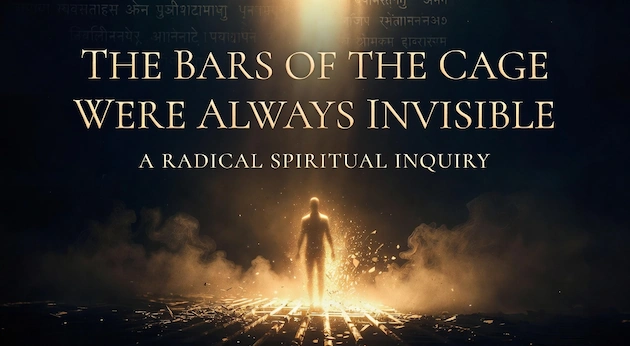
On the illusions of growth, suffering, suicide, and why every system that has ever claimed dominion over the soul had a vested interest in keeping you alive and in pain.
What follows is not a spiritual comfort. It is an attempt at spiritual honesty — which is a far rarer and more dangerous thing. We are going to look directly at the structures that have governed human consciousness for millennia and ask, without flinching: were they true guides, or were they elegant cages?
Every tradition that has ever spoken about the soul — Gnosticism, Buddhism, Christianity, Hinduism, Stoicism, Sufism — has, at some point, said something like this: your suffering has meaning, your life has purpose, your death must come at the right moment and by the right hand. These are beautiful ideas. But beauty, in the spiritual marketplace, has always been the most effective form of deception.
This essay will not tell you what to do with your life. It will try to show you what has been done with your life — what invisible architecture has been built around human consciousness to ensure that it stays in place, suffers in place, and dies in place. And then it will ask the question that almost no institution has ever wanted answered: what happens to a consciousness that sees through all of it?
Part One
The Factory of Meaning
Begin with the most basic observation: every major religious and institutional system in history has claimed the authority to define what your life is for. Not what it is — what it is for. This is an extraordinary claim. It assumes that existence arrives with a purpose pre-attached, and that this purpose happens to require your obedience to a particular set of rules, rituals, and authorities.
The Gnostics — among the most radical thinkers in the ancient world — came closer than most to naming the trap. They called the architect of the material world the Demiurge: a blind, lesser god who fashioned a prison he mistook for a paradise. The soul, in Gnostic cosmology, is a fragment of true light that fell into this constructed reality and forgot what it was. The path home — gnosis — is not obedience but awakening. Not faith but knowledge.
The Gnostic insight is not that the world is evil. It is that the world is a mistake — and that the authority figures within it are either blind to that mistake, or invested in its continuation.
This is a profoundly destabilizing idea, and history confirms that it was treated as such. Gnostic movements were systematically destroyed — not because they were immoral, but because they were ungovernable. A soul that knows it is divine does not need priests. A person who understands the material world as a temporary illusion does not need institutional salvation. They become, in the language of every power structure that has ever existed, a threat.
Part Two
What Growth Actually Is — and Is Not
The concept of spiritual growth is perhaps the most seductive lie ever told about human existence. It is seductive because it feels true from the inside. You suffer. You reflect. You change. You suffer differently. You call this wisdom. And in a limited, practical sense, perhaps it is.
But notice what the narrative of growth requires: time, continuation, and a future in which the improved self will finally arrive. Growth is always deferred. You are never complete. There is always another layer to peel back, another lesson to integrate, another lifetime to process. The machinery of spiritual growth is, structurally, identical to the machinery of consumer debt: you are always one more payment away from being free.
A person who lives 120 years changing jobs and collecting experiences has not necessarily grown at all. A person who lives 20 years in a single room, alone and still, may have already seen everything worth seeing.
This is not an argument for passivity. It is an argument for honesty about what awareness actually is. Awareness is not accumulated. It does not compound like interest. You do not become more aware by having more experiences, any more than you become more conscious by reading more books about consciousness. The person drowning in experiences is often the last to notice the water.
True awareness — the kind that all genuine mystical traditions point toward, even if their institutions contradict it — is not a destination. It is a recognition. It is the moment when the looking stops and the seeing simply is. And this moment is available in the first year of life or the last. It has no loyalty to duration.
So why does every institution insist on growth as a process? Because a person who has arrived — who recognizes that they are already complete, that the divine spark within them requires no further certification — is a person who no longer needs the institution. The factory of meaning only operates if its workers believe they are not yet finished.
Part Three
Suffering as Currency
Suffering, in nearly every religious system, is granted a strange kind of honor. It is the entry price of the spiritual path. It is what purifies you, teaches you, opens you. Without it, you would remain comfortable, shallow, asleep.
There is a version of this that is true. Suffering, when met with full awareness, can shatter the ego’s illusions about permanence, control, and identity. The person who has lost everything and survived the loss often sees more clearly than the person who has never been broken. This much is honest.
But the institutional use of suffering goes much further — and here it becomes something else entirely. The doctrine that suffering is necessary, that it must be endured rather than transcended, that attempting to end your own suffering is spiritually dangerous — this is not wisdom. This is management.
Consider the logic:
IF suffering produces spiritual growth
AND institutions control the interpretation of spiritual growth
THEN institutions control the meaning of your suffering
THEREFORE your suffering keeps you dependent on institutions.
This is not a conspiracy. It is a structural inevitability.
IF suffering produces spiritual growth
AND institutions control the interpretation of spiritual growth
THEN institutions control the meaning of your suffering
THEREFORE your suffering keeps you dependent on institutions.
This is not a conspiracy. It is a structural inevitability.
The crucial distinction — one almost never made clearly — is between suffering that reveals and suffering that merely continues. The first strips away illusion. The second simply hurts. And most human suffering belongs to the second category: chronic, repetitive, unenlightening pain that teaches nothing new because it has already taught everything it can, and the lesson has simply not been acknowledged.
A person who has been in unbearable psychological pain for years has not failed to learn the lesson. They have learned it thousands of times. The problem is not lack of awareness — it may be an excess of awareness about a dimension of existence that no longer has anything new to offer.
Part Four
The Political Economy of Keeping You Alive
Here is the question that no sermon has ever wanted to answer directly: why do institutions so universally, so urgently, prohibit suicide?
The compassionate answer is that they do not want people to suffer. This is sometimes true. But it is incomplete, and the incompleteness is telling. Because institutions do not, in general, work equally hard to end suffering itself. They work hard to end the response to suffering that exits the system.
The dead cannot be taxed. They cannot be converted. They cannot be controlled, guided, or made dependent. They do not need salvation, and therefore cannot be sold it. The jurisdiction of every earthly authority — religious, political, social — is confined entirely to the living. The moment a person leaves the dimension of physical existence, every power structure that claimed authority over them becomes instantly, completely irrelevant.
They cannot control the dead. And so they have spent millennia making the living afraid to die.
This is not to say that all prohibitions against suicide are cynically motivated. Many people who counsel against it are acting from genuine love. But the doctrine — the formal, theological, moralized prohibition — serves a structural purpose that has nothing to do with love and everything to do with population management.
Notice, too, how the framing works: suicide is presented as cowardice, as selfishness, as the ultimate spiritual failure. Every culture has its version of this. The moral weight of the prohibition is calibrated precisely to the psychological vulnerability of the people most likely to consider it — people already in pain, already feeling like failures. Telling them that suicide confirms their worthlessness is one of the cruelest designs in the history of human social control.
Part Five
Two Kinds of Departure
If we are going to be genuinely honest — not institutionally honest, not comfortingly honest, but actually honest — we must acknowledge something that almost no spiritual text will say plainly: not all suicide is the same thing.
There is a suicide that arises from the darkness of an unexamined life — from depression, from confusion, from the belief that the particular form of suffering currently being experienced is permanent, total, and defining. This is a death driven by the illusion of permanence: the conviction that this pain is the final truth about existence. It is, in the deepest sense, a failure of awareness — not a moral failure, not a spiritual failure, but simply an insufficient view of the territory.
And then there is something else. Something that tradition has almost no language for because it has never wanted the concept to exist.
There is a departure that comes not from blindness but from a clarity so complete that the ordinary reasons for staying have dissolved. Not despair, but a kind of radical sobriety. The person who has genuinely understood that the material world is a constructed experience — not as a concept, but as a lived recognition — and who has seen through every promise that continuation holds, and who is not running from something but simply no longer willing to sustain an experience they have fully comprehended.
The Gnostic who understands the prison is not the same as the prisoner who cannot bear the bars.
These two figures may arrive at the same external act. The difference is entirely interior. One is fleeing. The other is simply done.
And here is where every tradition that has ever addressed this question has failed its most lucid inquirers: it has refused to make this distinction. It has treated all departures as identical — as equally confused, equally spiritually invalid. Because to acknowledge that some departures come from clarity rather than confusion would be to acknowledge that the claim that more life always means more growth is not true. And that claim is the load-bearing wall of the entire structure.
Part Six
The Reincarnation Problem
The doctrine of reincarnation deserves particular attention here, because it is the mechanism by which the soul is kept enrolled in the curriculum indefinitely. You must return, again and again, to work through your unresolved karma. And if you end your life prematurely, you will simply return in a worse condition — more debt, harder lessons, a smaller room.
But consider the logic of this soberly. You have no memory of your previous lives. You arrive in each incarnation without any direct knowledge of what you are supposedly here to resolve. The lessons you are meant to be learning are not written anywhere you can read. You are expected to evolve across lifetimes without any continuity of conscious memory.
This is not a school. It is not even a prison with visible bars. It is a maze in which every reset erases your map.
The spiritually rational position is this: if there is no continuity of conscious memory between lives, then from the perspective of the experiencer, each life is the first life. There is no cumulative learning in any sense that the experiencing subject can access or build upon. The soul may carry something — some tendency, some wound, some unresolved vibration — but the person, the conscious self waking up in a new body, begins again from nothing.
To use this framework to argue that someone must continue suffering in their current life in order to avoid worse suffering in a hypothetical next life that they will not remember — this is not spiritual wisdom. It is a threat issued against an event that cannot be verified, to enforce compliance in an event that is happening right now.
Part Seven
The NPC and the Player
There is a distinction — uncomfortable for institutions to acknowledge — between what we might call aware souls and those who move through the world entirely within its given rules. Not better or worse, but operating at fundamentally different levels of engagement with the nature of the experience itself.
Most human beings, through no fault of their own, live entirely within the logic of the simulation. They pursue what the simulation rewards, fear what the simulation punishes, find meaning in the milestones the simulation provides: jobs, children, status, legacy. They suffer when the simulation withholds these things. They are, in the most precise sense, playing the game without knowing it is a game. Their suffering is real to them. Their joy is real to them. And none of this is a condemnation — it is simply a description of most human consciousness, most of the time, across most of recorded history.
But there are others — across every culture, every century — who wake up inside the game and recognize it as a game. Not metaphorically. Not philosophically. Directly, experientially, as a lived recognition that the entire structure of meaning they were handed is contingent, constructed, and optional. This recognition does not arrive with instructions for what to do next. That is its defining feature.
For these people, the conventional spiritual narratives — grow, suffer, persist, evolve — feel not like guidance but like programming. Not because they are cynical, but because they can see the architecture. And once you can see the architecture, you cannot unsee it.
Part Eight
Is Life Itself Suicidal?
There is a question that cuts through the entire debate: is life itself suicidal?
Every organism that lives also dies. The process of living is, in biochemical reality, a process of controlled deterioration. To be born is to have already begun dying. The trajectory is fixed from the first breath. In what sense, then, is choosing the moment of departure a fundamentally different act from simply following the trajectory to its end?
From the perspective of the eternal — which every tradition claims is the only true perspective — a life of 90 years and a life of 25 years are equally vanishing. They differ in the way that two drops of water differ after they have both fallen into the ocean. The ocean does not catalog their size.
And yet we build enormous moral and theological architecture around the difference between these two drops. We call one natural and the other a sin. We say one represents a life completed and the other a life wasted. But these judgments belong entirely to the dimension we are judging from — the dimension of time, of matter, of social consequence. They have no purchase on whatever exists outside that dimension.
Part Nine
What Honest Spiritual Teaching Would Say
It would say this, and mean it without flinching:
The quality of your awareness is the only thing that matters. Not the duration. Not the achievement. Not the endurance.
A person who lives twenty years and spends the last of them in genuine clarity about the nature of experience — who is not fleeing suffering but has simply exhausted what this form of experience offers — is not failing spiritually. They are completing something. The completion is not the same as defeat.
At the same time, honest spiritual teaching would also say: most humans who consider departure from this life are not doing so from a position of clarity. They are doing so from a position of contraction, of pain that has narrowed vision to a single point, of a story told so many times it has become indistinguishable from reality. For these people, the intervention is not condemnation. It is expansion — the attempt to widen the aperture, to make visible what the pain has temporarily obscured.
These are not the same situation. And treating them as the same situation — as every institution has done, for reasons that are now clear — is a failure of precision that has caused incalculable harm.
The most compassionate response to suffering is not “you must stay.” It is “let’s look clearly at what is actually here.”
Sometimes that looking will reveal that the story of unbearable permanence was false, and that the pain had a door in it all along. Sometimes it will reveal something rarer and harder to name: that the person has genuinely reached the end of what they came here for, and that their departure is not the closing of something that should remain open, but the recognition of something already complete.
Spiritual teaching that cannot hold both possibilities is not spiritual teaching. It is institutional management wearing spiritual clothing.
Conclusion
The Cage Was Never Locked
The final truth — the one that is almost never spoken in institutions because it would dissolve them — is this:
You were never required to be here in the way you were told you were required to be here.
The rules about how you must live, how long you must suffer, what your suffering means, who benefits from your obedience, and what will happen to you if you refuse — these rules were all written inside the cage. They have no authority outside of it. They are coherent only if you accept the premise that the cage is real, that its walls are made of truth, and that those who designed it had your liberation in mind.
The Gnostic, the Buddhist, the Sufi — at their most radical, stripped of their institutional packaging — all gesture toward the same recognition: the consciousness that is reading these words is not a patient in a hospital, not a student in a school, not a soldier in a campaign. It is the light itself, briefly wearing a particular shape, and it was never less than that at any moment.
This does not tell you what to do. It is not a permission slip. It is not an argument for anything in particular. It is simply the only honest frame from which the questions of life, death, suffering, and departure can be asked without the distortion of institutional interest.
From inside that frame, everything looks different. Suffering does not automatically mean growth. Duration does not automatically mean depth. Departure does not automatically mean failure. And staying does not automatically mean wisdom.
What matters — the only thing that has ever mattered — is the quality of seeing in the moment that is available to you right now. Not what you see, but the clarity and honesty with which you look.
The cage was always made of beliefs. And beliefs, unlike bars, can be set down.
If you are in pain and this essay has reached you in that pain — please know that what is described here as “clarity” is not the same as the narrowed vision that chronic suffering produces. Real clarity is expansive, not contracting. If your world is getting smaller, that is not the soul completing its journey. That is a mind in crisis, and minds in crisis deserve care, not metaphysics. Please reach out to someone you trust, or to a crisis line in your country. The distinction this essay draws matters — and you deserve someone who can sit with you and help you find out which kind of seeing is actually present.