1. Introduction: The Great Divide
Two Worlds in Apparent Opposition
In the theater of human understanding, two actors have taken the stage, each claiming dominion over truth itself. On one side stands Science—armored in methodology, wielding instruments of measurement, demanding proof through reproducible observation. On the other stands Spirituality—flowing like water through the cracks of materialism, speaking in whispers only the heart can hear, revealing truths that dissolve the moment we try to capture them in the net of language.
Yet this apparent opposition masks a startling irony. Max Planck, the father of quantum theory and Nobel Prize winner in 1918, declared with scientific authority what mystics had whispered for millennia: “I regard consciousness as fundamental. I regard matter as derivative from consciousness. We cannot get behind consciousness. Everything that we talk about, everything that we regard as existing, postulates consciousness.”
This divide appears absolute, unbridgeable as the chasm between matter and consciousness. Yet this very opposition reveals something profound about the nature of reality itself—and the limitations of both approaches when pursued in isolation.
2. The Tyranny of the Measurable
Contemporary science has erected what we might call the “Church of Measurement”—a sacred institution where only that which can be quantified, observed, and replicated is granted the status of “real.” This approach has yielded remarkable technological advances, yet it has also created a peculiar form of intellectual imprisonment.
Consider the profound irony: science, which claims to study universal truths, has become utterly dependent on technological instruments—devices that are themselves products of a particular moment in human civilization, bound by the materials and knowledge available at a specific point in spacetime. The electron microscope that peers into atomic structures is no more “universal” than the cave paintings of Lascaux or the astronomical instruments of ancient Babylon. Each represents humanity’s attempt to extend its sensory reach, but each is ultimately limited by the consciousness and technological capacity of its era.
This dependency reveals science’s most carefully hidden secret: rather than studying reality directly, it studies reality as filtered through human-created instruments, interpreted by human minds, and expressed in human language. As Werner Heisenberg, another quantum pioneer, recognized: “What we observe is not nature itself, but nature exposed to our method of questioning.” The supposed objectivity of science dissolves under scrutiny—it is, despite its claims, a profoundly anthropocentric enterprise, a projection of human consciousness attempting to understand itself by examining what it perceives as “other.”
Even more revealing is the fact that modern quantum mechanics has demonstrated what Heisenberg called the fundamental truth that “separation of the observer from the phenomenon to be observed is no longer possible.” Science itself has discovered that the very act of observation shapes reality—yet the implications of this discovery remain largely quarantined within physics departments, never allowed to infect the broader scientific worldview with its mystical implications.
The Ego-Driven Architecture of Scientific Recognition
Perhaps nowhere is the ego-centricity of modern science more apparent than in its system of recognition and authority. The Nobel Prize, peer review processes, academic hierarchies, and the cult of scientific personality all serve to reinforce individual identity rather than dissolve it in service of truth. Max Planck observed with characteristic precision: “Ego is the immediate dictate of human consciousness”—yet science has constructed elaborate mechanisms to celebrate and perpetuate exactly this ego-identification.
Consider the revealing patterns: between 1901 and 2023, Nobel Prizes have overwhelmingly been awarded to researchers from a handful of elite institutions, with over 40% of laureates affiliated with just 10 universities. This isn’t merely a coincidence but reflects deeper power structures where recognition flows toward those already embedded in networks of prestige. The same dynamic appears in the peer review process, where novel ideas from unconventional thinkers are often met with skepticism, while established paradigms are reflexively upheld.
When we examine why certain theories gain traction while others are sidelined, we find that the “who” matters as much as the “what.” Einstein’s theories, for instance, were not embraced solely for their brilliance but because he had navigated the academic system to achieve visibility and credibility. Conversely, transformative insights from researchers outside the dominant intellectual circles—whether due to geography, institutional affiliation, or unconventional approaches—often struggle to break through.
Take the case of Gregor Mendel, whose foundational work on genetics was ignored for decades because he was an obscure monk publishing in a minor journal. Or consider the resistance to plate tectonics, dismissed for years because it challenged the entrenched geological orthodoxy of the early 20th century. These examples reveal a systemic truth: scientific recognition is less about the purity of truth and more about navigating the social and institutional machinery of academia.
This dynamic exposes a troubling paradox: science, which aspires to objectivity, is deeply shaped by subjective forces. The scientific method may be rigorous, but its application is filtered through human tendencies toward gatekeeping, intellectual tribalism, and the reinforcement of established hierarchies. The result is a system where prestige, access to resources, and social capital often determine which ideas rise to prominence, revealing science not as a neutral arbiter of truth but as a profoundly human enterprise shaped by power and influence.
Science as an Instrument of Power
The Manufacture of Consensus
To stop at the critique of ego, however, is to miss the more insidious dimension. The institutional machinery of science is not merely subject to human bias; it is increasingly a primary instrument of social and political control. The term “science” has been weaponized, transformed from a methodology of inquiry into a secular catechism used to legitimize policy and silence dissent. Any challenge to an officially sanctioned narrative, regardless of its empirical or logical merit, can be dismissed as “anti-science,” a label that effectively excommunicates the holder from rational discourse.
This is not a rejection of the scientific method, but an exposure of its capture. Consider the historical precedent of Lysenkoism in the Soviet Union, where biological science was subordinated to state ideology with devastating consequences. In our contemporary context, the mechanism is more subtle but structurally identical: funding flows preferentially to research that reinforces dominant socioeconomic paradigms—be they pharmacological, agricultural, or economic—while inquiry into alternatives is systematically defunded and marginalized. The peer-review system, in this light, functions less as a quality filter and more as a gatekeeping mechanism that enforces ideological conformity, ensuring that the “scientific consensus” reliably reproduces the worldview of its funders and institutional hosts. The result is a form of epistemic totalitarianism, where the language of objectivity is used to mask a deeply political project.
3. The Invisible Validity of Inner Experience

Spirituality operates in a realm that science has declared non-existent: the domain of subjective, non-reproducible, non-measurable experience. Yet this dismissal reveals more about the limitations of scientific methodology than it does about the validity of spiritual insights.
Consider meditation, prayer, mystical experiences, or moments of profound inner knowing. These experiences may not be observable from the outside, but they possess a quality that external observations often lack: they are known with absolute certainty by the one experiencing them. A meditator knows beyond doubt when consciousness shifts into deeper states. A mystic knows with unshakeable conviction when the boundaries of personal identity dissolve into universal awareness.
This knowing is not inferential—it is not arrived at through reasoning or measurement. It is direct, immediate, and self-evident to the consciousness experiencing it. From a spiritual perspective, this direct knowing represents a higher order of evidence than anything science can provide, precisely because it eliminates the intermediary steps that scientific observation requires.
The Pathology of Spiritual Materialism
Yet spirituality faces its own shadow in what we might call “spiritual materialism“—the ego’s attempt to co-opt spiritual experiences for its own aggrandizement. When spiritual seekers collect experiences like trophies, compare their realizations with others, or use spiritual language to construct sophisticated forms of spiritual identity, they fall into the same ego-driven patterns that characterize institutional science.
True spirituality points toward the dissolution of the very sense of personal identity that drives both scientific recognition-seeking and spiritual materialism. It is the recognition that the seeker, the sought, and the seeking are all appearances within the same undifferentiated awareness. This recognition naturally transcends the need for external validation, whether scientific or spiritual.
The Supermarket of the Soul
Spirituality as Opiate
The modern “spiritual marketplace” represents the near-total victory of spiritual materialism. It has successfully commodified the transcendent impulse, selling prepackaged experiences of peace, purpose, and connection that carefully avoid challenging the core structures of the ego or the consumer society it serves. This is spirituality as a palliative, designed not to awaken but to anaesthetize.
Its primary product is a toxic form of bypassing masquerading as wisdom: the teaching that “everything is perfect as it is.” In its authentic context, this is a profound non-dual realization pointing to the inherent completeness of awareness itself. In the marketplace, it is weaponized to mean “your life, your society, and your suffering are perfect; no critical inquiry or transformative action is necessary.” It encourages a blissful complacency, a quietism that serves the status quo perfectly. The spiritual seeker is transformed into a consumer, shopping for accessories for their ego—a more enlightened identity, a more serene disposition—all while leaving the fundamental prison of separation utterly intact. This is not liberation; it is the most sophisticated form of bondage, because the prisoner has been convinced to decorate their cell and mistake it for the entire universe.
4. The Quantum Bridge
When Science Touches the Mystical
Ironically, it is at the furthest reaches of scientific investigation that the boundaries between science and spirituality begin to dissolve. Quantum mechanics has revealed aspects of reality that sound more like ancient mystical teachings than the mechanical universe of classical physics.
Max Planck, after decades of rigorous scientific investigation, reached a conclusion that would have been at home in any ancient spiritual text: “All matter originates and exists only by virtue of a force… We must assume behind this force the existence of a conscious and intelligent mind. This mind is the matrix of all matter.” This wasn’t mystical speculation but the considered judgment of the scientist who discovered energy quanta and laid the foundation for quantum theory.
The observer effect suggests that consciousness plays a fundamental role in determining physical reality. Quantum entanglement reveals instantaneous correlations across vast distances that transcend our ordinary understanding of space and time—what Einstein dismissively called “spooky action at a distance,” now experimentally verified beyond doubt. The principle of complementarity shows that the same phenomenon can exhibit completely contradictory properties depending on how it is observed, echoing the mystical teaching that ultimate reality transcends all dualistic categories.
Perhaps most significantly, quantum mechanics has revealed that at the deepest level, reality is not made of “things” at all but of relationships, probabilities, and information. As physicist John Wheeler famously proclaimed, we live in an “it from bit” universe, suggesting that information, not matter, is the fundamental substrate of reality. The solid, separate objects of classical physics dissolve into patterns of interconnection that mystics have described for millennia as the fundamental nature of existence.
The Measurement Problem as Spiritual Teaching
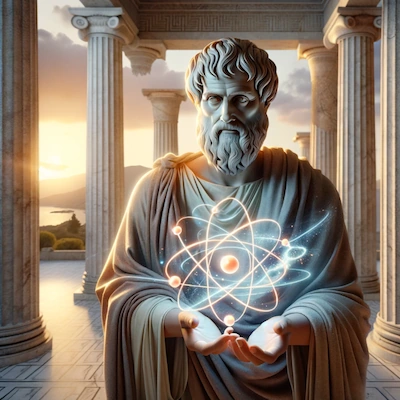
In quantum mechanics, the “measurement problem” refers to the enigmatic shift from a probabilistic wave function—where particles exist in multiple states simultaneously—to a single, definite outcome upon observation. Before measurement, an electron isn’t here or there—it’s everywhere and nowhere, a superposition of possibilities. But the moment we observe, the wave collapses, and reality crystallizes.
This mirrors a core teaching in non-dual spiritual traditions: that the world of form, separation, and identity arises from the act of mental fixation—the moment we identify as a distinct “I.” Prior to this identification, consciousness is pure, undivided, and infinite. The ego, like the observer in quantum physics, collapses the infinite field of awareness into a localized experience of “me” and “mine.”
Key Parallels:
- Observer Effect: In quantum physics, the observer influences the outcome. In spirituality, the ego shapes perception. Both suggest that reality is participatory, not passively received, but actively co-created.
- Superposition vs. Unity: Quantum particles exist in superposition until measured. Similarly, consciousness remains unified until the mind imposes duality—subject and object, self and other.
- Collapse as Creation: Measurement doesn’t just reveal reality, it creates it. Likewise, spiritual traditions teach that the world of separation is not discovered, but projected by the mind.
Spiritual Implication:
This isn’t just poetic analogy, it’s a radical invitation. If reality emerges through observation, then by shifting the observer—by loosening identification with the ego—we may glimpse the deeper field from which all forms arise. Meditation, self-inquiry, and contemplative practices aim to dissolve the “measuring mind,” allowing awareness to rest in its natural, uncollapsed state.
In this view, the quantum field and pure awareness are not metaphors for each other—they may be the same thing seen through different lenses. Physics describes the behavior of reality; spirituality explores its essence. And both whisper the same truth: the world is not as fixed or separate as it seems.
5. The Paradox of Progress
Science and spirituality grapple with a profound tension: the paradox of progress. Science dissects reality into minute fragments, mapping quarks, genomes, and galaxies with staggering precision. Yet the deepest questions—What is consciousness? Why does anything exist? What is time’s essence?—remain as elusive as ever, untouched by centuries of data. Neuroscience traces neural pathways but falters at the subjective richness of experience. Physics models the Big Bang but sidesteps why there is something rather than nothing. The more science learns, the more it reveals its own limits, like a mapmaker charting a coastline only to face an infinite sea.
Spirituality, by contrast, claims direct access to ultimate truth—through meditation, intuition, or transcendence. Mystics from the Upanishads to Zen describe a reality beyond language, yet this truth is ineffable, unprovable, and unshareable. Without critical rigor, spiritual insights risk dissolving into illusion or “spiritual bypassing,” where lofty ideals evade reality’s messiness. The mystic’s vision, however profound, remains a private spark, unmoored from collective understanding.
This paradox reveals a deeper truth: neither science nor spirituality alone can satisfy humanity’s yearning for meaning. Science, stripped of metaphysical context, becomes a sterile catalog of facts about a purposeless universe. Spirituality, without scrutiny, risks becoming self-deceptive fantasy. Yet their tension is an invitation—a call for a new epistemology that blends science’s rigor with spirituality’s depth. Thinkers like Teilhard de Chardin, who saw evolution as spiritual unfolding, or David Bohm, who wove quantum theory with metaphysical inquiry, hint at this synthesis. The paradox challenges us to transcend the binary of data versus mystery, to forge a path where empirical precision meets existential courage, lest our progress remain a brilliant but fragmented pursuit of truths we cannot fully grasp.
6. The Emergence of a New Paradigm
We may be witnessing the early stages of a paradigm shift—one that moves beyond the historical dichotomy between objective science and subjective spirituality. This emerging framework recognizes that consciousness and the cosmos are not isolated domains but interwoven dimensions of a unified, evolving reality. Within this view, empirical investigation and contemplative insight are not contradictory pursuits, but complementary modes through which the universe explores and understands itself.
Rather than merely reconciling science and spirituality, this paradigm redefines the epistemological foundations of both. Its methodologies may diverge significantly from conventional scientific practice—just as quantum mechanics departed from classical physics—and may also transcend traditional spiritual models, favoring integrative approaches over sectarian doctrines. It invites a synthesis of rational analysis, direct experience, and systems-level thinking.
The Spiritual Seek project represents an early-stage exploration of this integrative paradigm. It does not claim to offer definitive answers, but rather serves as a prototype for how inquiry into consciousness, meaning, and reality might evolve when disciplinary boundaries are softened. It reflects a growing recognition that understanding the nature of existence may require tools that are as fluid and multidimensional as the reality they seek to illuminate.
7. The Spiritual Seek Website
Outlining our philosophy and methodology
At The Spiritual Seek, we recognize that neither purely scientific nor purely spiritual approaches are sufficient for comprehensive understanding. Instead, we embrace what we call Spirituosophy—a revolutionary integrative paradigm that weaves together philosophical precision, spiritual depth, psychological insight, and quantum physics into a unified framework for exploring existence.
Spirituosophy emerges not as merely another discipline, but as what we term “a watershed moment in human understanding”—a convergence that restores the essential rivers of knowledge to their proper flow and reunites them in a single delta of integrated wisdom. As we articulate in our foundational work on this philosophy, humanity stands at a crossroads where “ancient wisdom meets quantum reality,” requiring nothing less than a renaissance of understanding that honors both the measurable and ineffable aspects of existence.

The Crisis Behind the Solution
Our civilization finds itself, as we observe, “balanced precariously on the knife-edge of transformation.” On one side lies the abyss of fragmentation, where philosophy has been relegated to dusty academic corners, spirituality commercialized into weekend workshops, psychology weaponized for manipulation, and quantum physics quarantined from its metaphysical implications. Spirituosophy addresses each of these fragmentations with surgical precision:
Philosophy’s Restoration: While contemporary academic philosophy often remains trapped in ivory towers speaking incomprehensible languages, Spirituosophy recovers philosophy as a living practice woven into everyday life. We restore Socrates’ method of questioning assumptions, Aristotle’s empirical observation, Eastern philosophy’s emphasis on direct experience, and Indigenous wisdom traditions’ recognition of interconnectedness, transforming philosophy from mere abstraction back to its original role as the love of wisdom (philo-sophia).
Spirituality’s Reclamation: Against the backdrop of spiritual materialism where “transcendence comes with a price tag,” Spirituosophy reclaims authentic spiritual practice from the marketplace. We recognize that genuine spiritual insight cannot be purchased but must be cultivated through contemplative practice, ethical living, and the courage to face one’s shadow aspects. By integrating spiritual experience with philosophical discernment and scientific inquiry, we resist commodification while honoring the legitimate human yearning for connection beyond materialism.
Psychology’s Liberation: Where mainstream psychology has become a tool for behavioral manipulation—from corporate marketing to political campaigns to addictive social media algorithms—Spirituosophy reclaims psychology as a force for human liberation. We integrate psychology’s empirical insights with philosophy’s ethical framework, spirituality’s transformative practices, and quantum physics’ recognition of consciousness as fundamental, returning psychology to its etymological roots as the “study of the soul.”
Quantum Physics Integration: Unlike mainstream scientific discourse that remains constrained by philosophical materialism despite quantum discoveries, Spirituosophy embraces quantum physics as a doorway opening onto new questions about consciousness and reality. We create a framework capable of addressing not just how the universe works at its smallest scales, but what this means for our understanding of ourselves as conscious beings participating in shaping reality.
The Method of Integral Investigation
This Spirituosophical approach manifests in several distinctive ways that transcend both conventional science and traditional spirituality:
Holistic Integration: We reimagine knowledge not as isolated domains but as a living ecosystem where insights flow between fields. Philosophy contributes critical thinking and metaphysical inquiry; spirituality offers experiential wisdom and contemplative practices; psychology illuminates the structures of mind and emotional patterns; quantum physics reveals the fundamental interconnected nature of physical reality. This integration creates what we call “stereoscopic vision”—depth perception that emerges from combining different perspectives.
Epistemological Breadth: Unlike Western intellectual traditions that have privileged only rational analysis and empirical observation, Spirituosophy recognizes multiple valid ways of knowing: analytical reasoning, sensory observation, intuitive insight, embodied wisdom, contemplative awareness, narrative understanding, and relational knowing. Each offers complementary windows onto multidimensional reality.
Phenomenological Precision: We bring the same rigor that science applies to external observation to the investigation of inner states. Rather than accepting vague spiritual generalizations, our assessments develop precise phenomenological maps of consciousness states, spiritual experiences, and developmental stages, revealing patterns that emerge with remarkable consistency across different individuals and traditions.
Recursive Self-Investigation: Perhaps most importantly, we recognize that any investigation of consciousness must include the investigator. This recursive quality—where awareness investigates awareness—is not a problem to be solved but a fundamental feature that must be embraced. Our approach transcends both analytical reasoning and spiritual intuition, evolving what might be called “trans-rational” intelligence.
Integration Beyond Synthesis: Rather than simply combining scientific and spiritual approaches, Spirituosophy seeks a perspective that transcends both while honoring the insights of each. This creates new possibilities for understanding that neither domain could access in isolation.
The Technology of Consciousness Exploration
Our approach to bridging science and spirituality manifests most concretely in what we call the “Technology of Consciousness Exploration”—sophisticated assessment tools and conceptual essays that represent a unique synthesis of ancient wisdom and contemporary psychological insight. These instruments transcend both conventional scientific measurement and traditional spiritual guidance by operating from non-dual understanding.
Unlike scientific tests that treat subjects as objects to be studied, our assessments recognize what Spirituosophy calls the “participatory nature of consciousness”—the test-taker is simultaneously the experimenter, the subject, and the instrument of investigation. This creates a fundamentally different dynamic where evaluation becomes contemplative practice, and self-examination generates deeper self-awareness.
Consider our Spiritual Awareness Test, which measures consciousness on a sophisticated scale across seven potential outcomes, exploring how we transcend what we termed earlier as “the prison of duality” as the mind evolves beyond rigid binary thinking. Using the metaphor of an ant versus a hawk, this assessment reveals whether one navigates life focused on immediate concerns or perceives underlying patterns and interconnections—a distinction that quantum physics echoes in its revelation of local versus non-local phenomena.
The Quiz of Inner Liberation represents perhaps our most sophisticated integration of spiritual wisdom with psychological precision. Inspired by the Hindu concept of Moksha, this assessment creates what we describe as “a symbolic recreation of the soul’s journey from first arrival on Earth through its gradual awakening to its true spiritual nature.” Participants navigate fourteen stages of consciousness evolution—a process that mirrors both ancient spiritual teachings and contemporary understanding of developmental psychology.
What distinguishes these tools from both conventional psychological tests and traditional spiritual guidance is their foundation in Spirituosophy’s core insight: consciousness is not just another object to be studied but the very ground of all experience—the perceiving presence within which all perceptions arise. This recognition transforms assessment from external evaluation into self-discovery, from diagnosis into awakening.
8. Beyond the Either/Or
A New Vision of Inquiry
The future of human understanding may lie not in choosing between science and spirituality but in discovering the deeper reality that makes both possible. This deeper reality is consciousness itself, not as a thing or substance, but as the fundamental capacity for experience, relationship, and knowing.
From this perspective, both the scientific laboratory and the meditation cushion are sacred spaces where consciousness investigates its own nature. Both the electron and the experience of enlightenment are appearances within the same field of awareness. Both the quest for objective truth and the journey toward self-realization are movements of the same underlying intelligence.
The profound recognition dawning in our time is that the observer and the observed, the seeker and the sought, consciousness and cosmos, are not separate entities but different faces of an indivisible wholeness. This recognition does not diminish either science or spirituality but reveals their deeper unity and higher purpose.
At The Spiritual Seek, we stand at this threshold, offering tools and insights for those ready to explore beyond the boundaries of conventional thinking. We invite you into a space where ancient wisdom and modern understanding dance together, where the precision of scientific inquiry meets the depth of spiritual realization, and where the greatest discovery is the recognition of who you have always been.
❓Frequently Asked Questions
The Science-Spirituality Interface
1. How is the term “Science” weaponized to enforce intellectual conformity?
The institutional apparatus of science often functions less as a neutral arbiter of truth and more as a secular priesthood. The label “scientific consensus” is frequently deployed not as a summary of evidence, but as a rhetorical cudgel to shut down inquiry that threatens established power structures—be they academic, corporate, or governmental. This creates a catch-22: any challenge to the consensus is branded “unscientific,” a designation that automatically disqualifies it from being heard within the very forums required to debate its scientific merit. This is not the scientific method; it is the politicization of scientific authority, a mechanism of social control that protects entrenched paradigms and the funding, careers, and worldviews that depend on them.
2. Has spirituality become the new opiate of the masses, a tool for complacency?
In its commodified form, absolutely. The modern “wellness” and “spirituality” marketplace is expertly engineered to sell comfort, not liberation. It promotes a gospel of feel-good affirmations, bypassing genuine shadow work and critical engagement with the world. By teaching that “everything is perfect as it is,” it encourages a blissful acquiescence to social, economic, and ecological dysfunction. This is spirituality as a palliative, designed to make the individual feel temporarily better about being a cog in a pathological machine, rather than awakening them to their role in transforming it. It is the ultimate triumph of consumer capitalism: the selling of enlightenment as a product that leaves the consumer’s ego—and the system it serves—fundamentally intact.
3. If Max Planck and other quantum pioneers recognized consciousness as fundamental, why does mainstream science still resist this understanding?
This resistance reveals what Spirituosophy identifies as the fundamental contradiction at the heart of contemporary scientific culture. While quantum mechanics has demonstrated what Heisenberg called the impossibility of separating observer from observed, accepting the full implications would require dismantling philosophical materialism—the foundational assumption that consciousness is merely an epiphenomenon of material processes.
Consider the institutional implications: entire academic departments, research programs, funding structures, and scientific careers rest on materialist assumptions. As Planck himself observed with characteristic insight: “A new scientific truth does not triumph by convincing its opponents and making them see the light, but rather because its opponents eventually die, and a new generation grows up that is familiar with it.” The resistance stems not from scientific evidence—which increasingly supports consciousness as fundamental—but from intellectual investment in worldviews that consciousness-based understanding would obsolete.
Spirituosophy navigates this transition by recognizing that we may be witnessing the emergence of what we call “post-materialist science”—an approach that includes but transcends mechanistic reductionism while maintaining empirical rigor.
4. If spiritual experiences can’t be measured or reproduced, how can we distinguish between genuine insight and self-deception?
This question strikes at the heart of spiritual discernment. While spiritual experiences cannot be externally validated through scientific methods, they can be evaluated through several other means: phenomenological precision (accurate description of the experience), transformative efficacy (does the experience lead to genuine positive change?), consistency with perennial wisdom (alignment with insights reported across cultures and centuries), and most importantly, the quality of being they engender (greater love, wisdom, peace, and freedom from ego-driven behavior).
Our assessments help individuals develop this capacity for spiritual discernment by revealing patterns in consciousness that are both personally meaningful and universally recognizable.
5. Why does modern science seem threatened by consciousness studies and spiritual experience?
The current scientific paradigm is built on the assumption that consciousness is either reducible to brain activity or irrelevant to understanding reality. Acknowledging the primacy of consciousness would require a fundamental revision of scientific materialism, similar to how quantum mechanics required a revision of classical physics. This threatens not just theoretical models but entire careers, institutions, and worldviews built on materialist assumptions. The resistance often stems from intellectual investment rather than genuine scientific skepticism.
6. What evidence exists that consciousness is fundamental rather than emergent from brain activity?
While this question assumes the framework of scientific evidence, several lines of inquiry point toward consciousness as fundamental: the “hard problem of consciousness” in neuroscience (why subjective experience should exist at all if the brain is just information processing), quantum mechanics’ measurement problem (the apparent role of observation in determining physical reality), near-death experiences and other exceptional human experiences that challenge brain-based models, and the philosophical problem of how unconscious matter could give rise to conscious experience.
More importantly, the evidence that consciousness is fundamental is available through direct investigation—the same consciousness that questions its own nature is the consciousness that can discover its primacy through careful self-inquiry.
7. How can ancient wisdom traditions possibly be relevant to modern understanding when they lack scientific rigor?
This question reveals a profound misunderstanding of both ancient wisdom and genuine scientific rigor. Traditions like Advaita Vedanta, Buddhist psychology, or Christian mysticism represent thousands of years of systematic investigation into the nature of consciousness, arguably the most rigorous experimental program in human history. The “laboratories” were human consciousness itself, the “experiments” were contemplative practices, and the “results” were validated through direct experience across cultures and centuries.
Modern science has been rigorous about external phenomena for only a few centuries, while contemplative traditions have been rigorous about internal phenomena for millennia. Both forms of rigor are valuable, and true comprehensiveness requires both.
8. What role does quantum physics actually play in spiritual understanding, and isn’t this connection often overstated?
The significance lies not in specific parallels—observer effects “proving” the power of consciousness, or entanglement “proving” mystical interconnection—but in quantum physics having forced the collapse of philosophical materialism within the most rigorous scientific domain. As Planck recognized, quantum investigations reveal that “we cannot get behind consciousness” and that matter itself may be “derivative from consciousness.”
This creates unprecedented space for dialogue between scientific and contemplative investigations of reality. Spirituosophy suggests that both quantum physicists and contemplative practitioners are investigating the same fundamental questions about the nature of consciousness, causation, and the relationship between observer and observed—using different methodologies but potentially discovering complementary aspects of the same underlying reality.
The connection is neither overstated nor understated but properly understood as mutual illumination rather than simple correlation. Quantum physics challenges scientific materialism from within science itself, while contemplative traditions offer sophisticated methodologies for investigating consciousness that quantum physics reveals as fundamental but cannot directly study through external measurement.
9. If quantum mechanics really supports mystical insights, why do most physicists reject this connection?
Most physicists receive training in mathematical formalism but little education in consciousness studies or contemplative practice. They can manipulate the equations of quantum mechanics without necessarily understanding their deeper implications for the nature of reality. Additionally, academic physicists operate within institutional structures that discourage philosophical speculation in favor of technical problem-solving.
However, many of the founders of quantum mechanics—Einstein, Bohr, Heisenberg, Schrödinger—were deeply philosophical and recognized the mystical implications of their discoveries. The current generation of physicists may simply be catching up to insights their predecessors understood decades ago.
10. What is the relationship between The Spiritual Seek’s assessments and traditional forms of spiritual guidance?
Our assessments serve as a contemporary form of what traditional spiritual schools called “spiritual diagnosis”—the capacity to accurately perceive an individual’s current developmental stage, psychological patterns, and spiritual needs. Just as a traditional guru or spiritual director would evaluate a student’s readiness for different practices, our tools help individuals understand their current spiritual configuration.
The difference is accessibility and precision. Traditional guidance required finding a qualified teacher and often years of preliminary training. Our assessments make sophisticated spiritual assessment immediately available while maintaining the depth and accuracy of traditional methods.
11. How do you avoid the trap of “spiritual materialism” while still offering spiritual assessments and tools?
Spiritual materialism occurs when the ego co-opts spiritual concepts, experiences, or practices for its own aggrandizement. Our approach guards against this in several ways: First, our assessments are designed to reveal rather than inflate the ego’s strategies. Second, we emphasize that all spiritual “achievements” are temporary appearances within awareness—they are not possessions of a separate self. Third, we consistently point toward the recognition that the seeker, the path, and the goal are all arising within the same undifferentiated consciousness.
The ultimate purpose of any authentic spiritual tool is to reveal its own unnecessary nature, like a ladder that dissolves once you’ve climbed to the roof.
12. Why should someone trust The Spiritual Seek’s spiritual assessments over established psychological tests?
We wouldn’t necessarily suggest trusting our assessments over established psychological tests. Conventional psychological assessments have decades of research, validation, and clinical testing behind them, which gives them significant credibility for understanding personality patterns and psychological functioning.
Our assessments serve a different purpose—they’re designed to explore spiritual and contemplative dimensions of experience that conventional psychology doesn’t typically address. They operate from a non-dual understanding—they recognize that the person taking the test is an appearance within consciousness, and that the deepest insights come not from cataloging psychological patterns but from recognizing the awareness in which all patterns arise.
Rather than replacing psychological assessments, our tools might complement them for people interested in exploring both psychological and spiritual aspects of their experience. We recognize that our approach is based on certain philosophical assumptions about consciousness and spirituality that not everyone shares, therefore we encourage users to approach them with an open mind, like a genuine soul-searcher.
13. How does The Spiritual Seek navigate the challenge of communicating non-dual truth in dual language?
This is perhaps the central paradox of spiritual communication, using concepts and words to point toward that which transcends all concepts and words. We navigate this through what we call “transparent conceptuality”, using concepts and frameworks that simultaneously point beyond themselves.
Every question in our assessments, every explanation in our results, every article on our platform is designed to be self-transcending, to serve its function and then dissolve, like stepping stones across a river. The goal is not to create new spiritual concepts but to use concepts skillfully to catalyze direct recognition.
Any information you find on this website should be seen as a starting point, food for thought or a source of inspiration, rather than as a final statement. Since our sole objective is self-knowledge, we have no aspirations to scientificity, even though we frequently draw on established notions from scientific research to develop our distinctive content.
14. How does The Spiritual Seek’s approach address the criticism that spirituality is just wishful thinking or emotional comfort-seeking?
Authentic spirituality is actually the opposite of wishful thinking—it involves facing reality as it is rather than as we wish it were. This includes acknowledging the impermanence of all experiences (pleasant and unpleasant), the constructed nature of personal identity, and the inevitability of uncertainty and change.
Our assessments and in-depth articles often reveal uncomfortable truths about spiritual bypassing, unconscious patterns, and ego-driven motivations. True spirituality is more challenging than materialism because it requires giving up the comforting illusion of being a separate, permanent self in control of experience.
The difference between authentic spirituality and wishful thinking is that authentic spirituality leads to greater capacity for life as it is, while wishful thinking maintains resistance to reality.
15. What makes The Spiritual Seek’s Spirituosophical approach different from other spiritual or scientific websites?
The Spiritual Seek operates from what we call “integral discernment”—a perspective that emerges from Spirituosophy’s recognition that philosophy, spirituality, psychology, and quantum physics are not separate domains requiring bridge-building but expressions of a single, multidimensional investigation into the nature of existence. Unlike approaches that either reject science in favor of faith or dismiss spirituality as superstition, Spirituosophy addresses what we identify as the crisis of fragmentation that has left each discipline diminished—philosophy exiled to academic margins, spirituality commercialized into marketplace experiences, psychology weaponized for manipulation, and quantum physics quarantined from its metaphysical implications.
Our assessments and content emerge from this integral vision, offering tools for self-discovery that are simultaneously psychologically sophisticated, spiritually transformative, philosophically rigorous yet scientifically informed, without making any claims to truth. We restore depth to traditions that have been flattened by modern culture while creating new possibilities for understanding that neither scientific nor spiritual approaches could access in isolation.
16. What is the ultimate purpose of The Spiritual Seek’s approach to bridging science and spirituality?
Our ultimate purpose is to facilitate the recognition that science and spirituality, observer and observed, consciousness and cosmos, are not separate phenomena requiring bridge-building but expressions of a single, undifferentiated reality. The “bridging” is actually a recognition, like suddenly seeing that what appeared to be two separate rivers were always part of the same ocean.
This recognition transforms both scientific and spiritual investigation from activities of a separate self trying to understand an external world into expressions of the universe investigating its own nature. From this perspective, every moment of inquiry—whether through a microscope or meditation—is the cosmos coming to know itself more fully.
The Spiritual Seek exists to support individuals in making this recognition and living from its implications. Our assessments, articles, and resources all point toward the same fundamental understanding: You are not separate from what you seek to understand. The seeker, the seeking, and the sought are one seamless movement of awareness knowing itself.
Where ancient wisdom meets quantum mysteries, and the observer becomes the observed.