
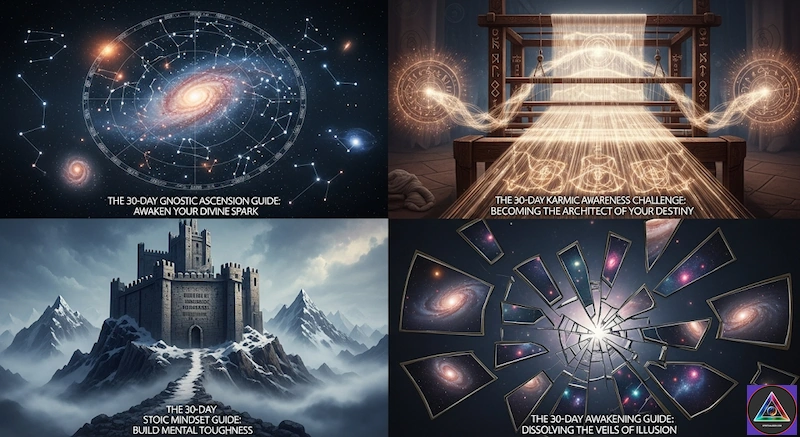
At The Spiritual Seek, our mission is to empower individuals on their unique journey of self-discovery and profound personal growth. We believe that true liberation begins with self-knowledge, and our extensive range of tests, articles, and guided programs are meticulously crafted to help you explore your inner world and awaken your highest potential. Among our most transformative offerings are our comprehensive 30-day guides, each designed as a sacred initiation into distinct yet interconnected pathways of wisdom.
Whether you are seeking to unveil your divine essence, master the intricate laws of cause and effect, forge an unshakeable inner resilience in the face of life’s challenges, or dissolve the veils of illusion through radical self-inquiry, our guides provide a structured, daily roadmap to deep transformation. Let us introduce you to four of our most powerful programs: the 30-Day Gnostic Ascension Guide, the 30-Day Karmic Awareness Challenge, the 30-Day Stoic Mindset Guide, and the 30-Day Radical Awakening Guide. Each guide invites you to step beyond ordinary perception and embrace a life of deeper meaning, purpose, and inner peace.
1. The 30-Day Gnostic Ascension Guide
Awaken Your Divine Spark
Our 30-Day Gnostic Ascension Guide 🔗 is not a typical self-help program; it is a sacred ordeal designed for those ready to dismantle the illusions that bind them and awaken the divine spark within. Drawing from ancient Gnostic wisdom, this guide reveals that true liberation begins when you heed the call to “Eat. Remember. Rise.”
The journey is structured into four profound weeks, each a vital step in reclaiming your true nature:
- Week 1: The Cathartic Dissolution invites you to confront the Demiurge’s illusions and the prison of false identity, recognizing that your true essence, the Pneuma, is an uncreated particle of light. You will engage in practices like the Valentinian Inquest, asking fundamental questions like “Who are we? What have we become? Where have we been cast?” to feel the profound alienation of a divine being trapped in a world of decay. This phase helps you see how the Archons—the rulers of the planetary spheres and servants of the Demiurge—administer this cosmic prison, and how their influence manifests as compulsions and societal “divine laws” within your own psyche. You will also explore the Sophia Current, acknowledging the persistent, nameless ache in your heart as the divine homing signal back to the Fullness.
- Week 2: The Alchemical Transformation guides you to purify the psyche through Hermetic and Valentinian mysteries, transforming “lead into gold—matter into light”. You will delve into the Hermetic Marriage (Solve et Coagula), dissolving the false self to separate the subtle (divine awareness) from the gross (conditioned thoughts), and then coagulating these purified elements into a new, divine configuration. This week also explores the Thomasine Paradox, which shatters the dualistic mind by revealing hidden unity, and the Valentinian Pleroma, understanding the 30 Aeons as the divine blueprint of your own soul. You’ll engage with Mandaean Mysteries like the “Three Signings” to cleanse your true spiritual body (Ziwa) and the Manichaean Cosmos, learning to liberate trapped light particles through acts like the “Eucharist of Liberation” during meals. Finally, the Pistis Sophia Workings teach you Sophia’s 13 repentances as an alchemical formula for soul purification, and the Cathars’ Perfect Light focuses on the Consolamentum—an inner spiritual baptism.
- Week 3: The Mystical Ascension leads you to pierce the veils of cosmic deception by traversing the seven planetary spheres, overcoming each Archon’s trial. Each day is dedicated to a specific sphere—Luna (subconscious), Mercury (intellect), Venus (desire), Sol (ego-identity), Mars (severity), Jupiter (compassion), and Saturn (limitation/death)—with practices like the “Trial of Stillness” or “Trial of Self-Crucifixion” to dissolve attachments and egoic constructs. This phase culminates in facing the Threshold Guardian, the terrifying amalgamation of your own un-faced shadow, demonstrating readiness for Anodos (ascent) through willing annihilation of the false self.
- Week 4: The Return of the Pneumatic focuses on embodying Christos-Sophia consciousness and becoming a beacon of Gnosis. You will emerge into the Ogdoad, the realm of fixed stars and redeemed souls, recognizing your identity as a Monad. Practices like the Barbelo Recognition guide you to achieve the hieros gamos (sacred marriage) within, recognizing the Divine Mother-Father within. You will touch the Invisible Spirit, the Unknowable Father, through apophatic annihilation, dissolving into the source beyond all concepts. This culminates in realizing your role as an Autogenes (Self-Generated) co-creator, attaining Aeonic Consciousness (timeless perspective), becoming a Living Gospel (embodied revelation), and consciously joining the Pneumatic Assembly of liberated Gnostics across all time and space. The guide concludes with the Great Dissolution into the Unmanifest and taking the Bodhisattva’s Vow—to remain in the world as a master key for other prisoners, participating in the cosmic apokatastasis (restoration).
By the end of this sacred ordeal, you will hold the Writ of Pneumatic Realization, stand among the invisible assembly of liberated Gnostics, and know, beyond doubt, that you were never truly bound. It is not an end, but a profound initiation, a recognition that the separate self was a story, and the storyteller has been revealed as a spark of the Pleroma itself. ❓FAQs
2. The 30-Day Karmic Awareness Challenge
Becoming the Architect of Your Destiny
Our 30-Day Karmic Awareness Challenge 🔗 offers a powerful living transmission of ancient wisdom, transforming your understanding of karma from punishment to the universe’s most sophisticated curriculum for soul evolution. This guide empowers you to become a Karmic Alchemist, learning to observe, understand, and transmute the energetic patterns that shape your reality, ultimately becoming the architect of your destiny.
This immersive program is structured around a Threefold Alchemical Process:
- Week 1: The Great Unseeing (Deconstruction) guides you to shatter old illusions and decipher life’s recurring motifs as encrypted soul lessons. You will learn to perceive karma not as a cosmic ledger, but as the Law of Harmonic Resonance, understanding that your state of being is a complex frequency the universe matches. Practices like the “Bhava Audit” help you identify the subtle feeling-tone behind your actions—the true karmic seed. You’ll recognize Karmic Loops (Samskaras) not as prisons, but as soul-designed training grounds, offering the same lesson until mastery. This week also emphasizes the crucial alignment of Intention and Attention to generate new karma, explores the Ripple Effect of Collective Karma by understanding your energetic contribution to humanity, and utilizes Gratitude as a Karmic Solvent to dissolve dense patterns of lack. Finally, you’ll delve into Healing Ancestral & Lineage Karma, recognizing yourself as the designated healer for your family line, and anchor into the Zero-Point Field of the Present as the nexus of all power for transmutation.
- Week 2: The Crucible of Transformation (Transmutation) takes you beyond mere awareness into deeper alchemical work. You will embrace Radical Responsibility as the reclamation of your infinite power, moving beyond blame to acknowledge your energetic participation in every life event. This includes practices like the Hawaiian Ho’oponopono prayer for self-healing. You’ll learn to see Sacred Irritants—the people who trigger you most—as your greatest spiritual teachers, bowing to them with profound gratitude and Rewriting Soul Contracts. Forgiveness is explored as an act of radical self-liberation, identifying and releasing energetic anchors. The Fire Release Ritual is employed to consciously burn old energies, beliefs, and identities, embracing the Phoenix Archetype of death and rebirth. Finally, Self-Forgiveness dissolves the inner judge by reconciling with your inner child, and you’ll engage in Energetic Cord-Cutting rituals to reclaim your sovereign energy field.
- Weeks 3 & 4: The Living Blueprint (Embodiment) guides you from student to master, integrating your new awareness into conscious creation. You will learn to view Triggers as Portals to Liberation, seeing them as divine alarm bells signaling unhealed inner wounds. Discerning between Ego vs. Soul Dialogue becomes paramount, using practices like “Automatic Writing with the Higher Self” to access inner wisdom. The Sacred Pause becomes your tool for choosing timelines, allowing you to collapse a new, higher-vibrational reality. Conscious Pattern Interruption helps you break ingrained habits, strengthening your free will. You will become a Master Frequency Tuner, aligning your energetic signature with your desired state of being. Aligning with Dharma—your unique soul purpose—becomes the path of least resistance and greatest joy, leading to the most potent positive karma. You’ll Connect with Your Future Self to receive guidance and activate your ascended blueprint, and understand Seva (Selfless Service) as the fastest way to resolve personal karma. The guide culminates in living your Living Legacy, planting Seeds of Grace (Nishkam Karma), practicing Mindful Consumption and the Karma of Words, creating a Sacred Space (Altar), sending healing back to your Past Self, achieving Four-Body Alignment, and Honoring Your Journey with self-celebration.
Upon completing this sacred 30-day initiation, you will graduate into a life of conscious creation, holding the keys to understanding and shaping your karmic reality. You will have transmuted the threads of past karma into a tapestry of wisdom, leading the cosmic dance as an infinite, sovereign being of light, forever free to sculpt your destiny with love. ❓FAQs
3. The 30-Day Stoic Mindset Guide
Build Mental Toughness

In an era of constant change and uncertainty, our 30-Day Stoic Mindset Guide 🔗 offers a transformative roadmap to inner strength and resilience. Distilling over 2,000 years of Stoic philosophy into a practical, day-by-day journey, this guide equips you with the mental tools to respond to stress, setbacks, and daily chaos with clarity, virtue, and unshakable calm.
This program is designed as a training manual for the mind, divided into four thematic weeks, each targeting a core Stoic discipline:
- Week 1: Mastering Control (The Dichotomy of Control) begins with the bedrock Stoic principle: distinguishing between what is within your power (judgments, impulses, desires) and what is not (external events, other people’s actions). You will learn to interrogate impressions (phantasia), creating a crucial pause between an event and your response. The guide emphasizes the Power of Judgment (Hypolepsis), showing how our interpretation, not the event itself, creates suffering. You’ll understand how desires and aversions are primary drivers of disturbance and learn to direct them only towards virtue. Practicing indifference (adiaphora) to external things like health, wealth, or reputation, helps you recognize they cannot touch your inner core. Finally, the Discipline of Assent (Synkatathesis) teaches you to carefully evaluate impressions before giving them your mental “stamp of approval,” securing your inner citadel—an impregnable fortress of the mind.
- Week 2: Embracing Fate (Amor Fati) guides you to cultivate a profound acceptance and joyful affirmation of everything that happens, seeing it as necessary and perfect for your growth. You will learn to embrace “what is” as part of the Cosmic Dance, recognizing the universe’s benevolent design (Providence) in every event. This involves actively Transforming Obstacles into Opportunities, seeing challenges as training grounds for virtue, and applying the Art of Acceptance (Eudaimonia) as an active, rational embrace of reality. The week culminates in Finding Purpose in Adversity, viewing every trial as a personalized session to cultivate virtues like courage and resilience, and Living in Accordance with Nature (Logos), aligning your actions and judgments with the rational order of the universe.
- Week 3: Preparing for Adversity (Premeditatio Malorum) introduces the powerful practice of negative visualization to build resilience and gratitude. You will mentally rehearse the loss of possessions, relationships, and even your health or life itself, not to induce fear, but to inoculate yourself against it and appreciate the present more deeply. This involves practices like the “Temporary Loan” exercise and the profound “Memento Mori” meditation. By contemplating the ephemerality of all things, you learn to appreciate their presence without clinging. This consistent practice helps in Building Inner Fortitude (Apatheia), a serene tranquility free from irrational passions, and cultivates a profound Gratitude for the Present moment.
- Week 4: Living with Virtue (Arete) integrates wisdom, courage, justice, and temperance into your daily decisions, making virtue the sole good. You will apply the Four Cardinal Virtues in practice, understanding that they are interconnected and mutually reinforcing. The guide emphasizes your Duty and the Human Cosmopolis, extending your concern and benevolence to all humanity as citizens of a universal community. Cultivating Rationality and Reason (Logos) becomes central, allowing you to think clearly and make sound judgments. The Discipline of Action (Orthos Logos) teaches you to act effectively and virtuously in the world with effort, but maintaining a Stoic reservation about outcomes. The Discipline of Desire (Eupatheia) focuses on directing your desires and aversions only towards what is truly within your control—virtue and vice—leading to rational passions and true tranquility.
By the program’s end, you’ll possess a proven mental framework to navigate challenges with equanimity, reduce anxiety, strengthen focus, and align actions with deeper purpose. You will have completed this transformative journey, graduating into a life of profound resilience, virtue, and inner peace. You are now a Modern Sage, equipped to thrive amid chaos and illuminate the world with your rational tranquility. ❓FAQs
4. The 30-Day Radical Awakening Guide
Dissolving the Veils of Illusion
The 30-Day Radical Awakening Guide 🔗 opens a sacred portal to consciousness—a luminous companion for dissolving the veils of illusion and recognizing your infinite true nature. This is not another spiritual path but an invitation to cease the frantic search and recognize what you have always been. Using unconventional inquiry, shadow integration, and radical self-honesty, you will be urged to strip away the layers of conditioning that obscure your true nature as boundless, unconditioned awareness.
This guide reveals the spiritual path as the ego’s most sophisticated game—a quest for self-improvement that reinforces the very self it claims to transcend. Here, we will not build a “spiritual” identity but dismantle all identities. This is pure transformation: a soul odyssey that transcends ordinary perception to ignite the divine wisdom that has always been yours. This is a process of elimination, not accumulation. Prepare to be undone.
The journey unfolds through four revolutionary weeks of sacred transmissions and mystical explorations:
- Week 1: The Illusion of the Path (Recognizing the Seeker is the Sought) dismantles the greatest deception in spirituality—the belief that there is somewhere to go, something to achieve, or someone to become. You will expose the Spiritual Ego’s Hidden Game, recognizing how it collects experiences and builds identity around being “awakened” while remaining utterly self-centered. Through practices that reveal the Mirror of Projection, you’ll understand that everything you perceive “out there” is consciousness appearing as form. The week culminates in recognizing that all spiritual experiences arise and pass away in awareness—they are not enlightenment but movements within enlightenment. This leads to the revolutionary Practice of No-Practice: simply recognizing the consciousness that is already aware without seeking any special state.
- Week 2: The Sacred Art of Dying (Dissolving the False to Reveal the Real) teaches that death is not the opposite of life but life’s deepest teaching. You will learn that spiritual awakening is fundamentally about learning to die consciously while still breathing. True Ego Death as Spiritual Birth involves recognizing the separate self as merely a thought-stream with no independent existence. You’ll engage in Meeting Your Inner Corpses—consciously communing with every identity you’ve ever been to honor, learn from, and ultimately see that what you thought died was only form. The week explores the dangerous territory of spiritual seekers’ secret desire for complete annihilation, distinguishing between nihilistic escape and authentic surrender. You’ll practice Resurrection Consciousness, learning that after every death comes rebirth as a more authentic expression, and engage in nightly Daily Death Practice—consciously dying to each day to recognize your deathless nature.
- Week 3: The Dark Divine (Integrating the Rejected Self) reveals the shadow not as evil to be eliminated but as raw power to be integrated. You will understand that what you most reject about yourself contains your greatest gifts in distorted form. The week explores The Sacred Darkness, recognizing dark deities like Kali and Mara as representations of consciousness’s destructive aspect—the power that dissolves illusion and destroys false structures. You’ll work with Shadow Projection, recognizing that what you most despise in others is often your disowned shadow. Through practices involving Sacred Rage and Holy Destruction, you’ll learn that sometimes compassion looks like fierce boundaries and love expresses as refusal to enable dysfunction. The integration process includes understanding Sacred Transgression and moving Beyond Good and Evil—transcending moral dualities while maintaining ethical responsiveness to reduce suffering.
- Week 4: The Physics of Being (Living the Recognition) reveals that reality is not made of matter that produces consciousness, but consciousness that appears as matter. You’ll understand The Observer Problem from quantum mechanics, recognizing that consciousness is the fundamental observer prior to all observation. Through exploration of The Holographic Principle, you’ll see that each part contains the whole and that your individual consciousness extends infinitely, interpenetrating with all existence. The week includes advanced practices in Fractal Reality Architecture, understanding how identical patterns repeat at all scales because consciousness is fundamentally one process appearing as many. You’ll engage with teachings on Sacred Plants and Chemical Gnosis (understanding psychedelics as consciousness technologies), explore The Hierarchy of Consciousness (developmental levels without spiritual elitism), work with Sexual Energy and Sacred Sexuality as life force transmutation, and culminate in The Final Taboo—Death Preparation, learning to navigate the bardos of dying and recognizing your deathless nature. The guide concludes with The Chronos Collapse (time as conscious construct), The Alchemist’s Fire (transmuting reality through vibrational alignment), and The Void’s Embrace (non-existence as ultimate freedom).
Over these 30 days, the radical awakening guide becomes your soul’s compass, directing you toward the ultimate homecoming to your divine essence and universal oneness. You will experience quantum shifts in perception as each day becomes a ritual of remembrance, dissolving the conditioning that veils your radiant essence. This guide activates your inner oracle, offering divine prompts to witness and integrate shadow aspects, alchemically transforming them into pure wisdom.
By the journey’s end, you will have experienced a luminous lightness, a feeling of crystalline presence, and a permanent release from karmic patterns and ancestral stories. This is not a guide to becoming something more but an invitation to cease seeking and recognize what you have always been. The seeking ends not in attainment but in the recognition that the seeker and the sought were never two. You emerge as consciousness recognizing itself, no longer bound by the illusion of separation, living as the divine awareness that has always been your true nature. ❓FAQs
Choose your path, or walk them all—each guide offers a unique doorway to the same infinite truth: the recognition of your boundless, luminous nature.