
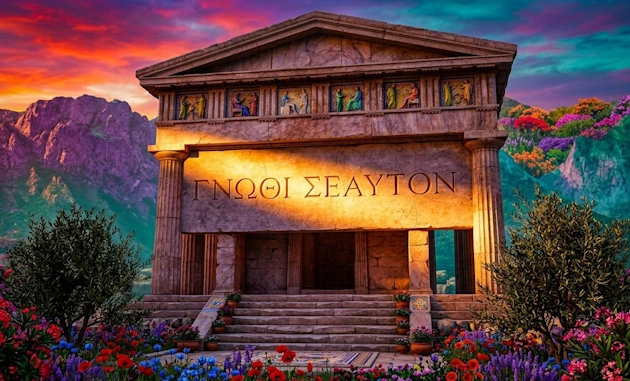
These two words, carved in stone above the entrance to Apollo’s temple at Delphi, have outlasted empires, religions, and philosophical schools. Their longevity is not ornamental — it is a sign of their difficulty.
You can read it in the header of this website because it is our motto, and most likely you have encountered it many times before: “Gnōthi Seauton“, translated into English as “Know Thyself“. But what is its origin, and what does it actually mean? Far from being a mere philosophical curiosity, these words point to what many traditions have regarded as the most demanding — and most necessary — of all human tasks.
The Delphic Oracle: Where Heaven Meets Earth
This maxim was engraved on the pronaos — the forecourt — of the temple of Apollo at Delphi, a sanctuary built on the steep southern slopes of Mount Parnassus in central Greece. Considered the omphalos — the navel of the world — Delphi housed the most prestigious Oracle of antiquity, the Pythia, a priestess of Apollo who delivered responses to petitioners from a chamber deep within the temple, in an altered state that ancient sources attributed to divine possession.
Visitors would travel for days or weeks, from across the Greek world and beyond, seeking guidance on matters of war, governance, and personal fate. But before entering the inner sanctum, all encountered these words: “Gnōthi Seauton.” This was not a welcome but a challenge — a prior condition placed upon every seeker before consulting the god. It urged visitors to examine themselves honestly: to know who was actually asking the question, and why. The inscription implied that without such preliminary self-examination, any oracle received would be misread, misapplied, or simply wasted.
The ancients understood that divine knowledge and self-knowledge were not separate pursuits. To approach the sacred without self-awareness was, in this tradition, a form of presumption.
Socrates: The Barefoot Philosopher’s Revolution
Among the figures most transformed by this aphorism, none embodied its demands more rigorously than Socrates — the philosopher who wandered the streets of Athens engaging citizens in conversations they found deeply unsettling. Socrates took “Know Thyself” out of the sanctuary and into the marketplace, treating it not as a religious inscription but as the founding principle of an entire way of living.
According to Socrates, the search for truth — which he believed dwelt latently in every human soul — was possible only by turning the gaze inward and submitting one’s assumptions to genuine, sustained scrutiny. For him, knowledge was not a body of information to be accumulated but a process of continual questioning in which certainties dissolve and more honest, more tentative understandings gradually emerge. Out of dialogue comes analysis; out of analysis, further questions. Doubt, in this framework, is not an obstacle to wisdom but its necessary beginning.
The Socratic method — called maieutics, or “midwifery,” by Plato — was founded on the conviction that truth was not something to be deposited into a person from outside, but something to be drawn out from within, as a midwife assists in a birth that is already underway. “I cannot teach anybody anything,” Socrates is reported to have said. “I can only make them think.”

The Sacred Power of Dialogue: Socrates’ Living Philosophy
Socrates left nothing written — not a single text. This was not incidental but philosophical. For Socrates, a written argument is a fixed thing: it cannot answer back, cannot adjust itself to the particular confusion or resistance of its reader, cannot be pressed and questioned until it either holds or breaks. Living conversation, by contrast, is irreducibly dynamic. Philosophy, in his view, had to breathe and respond; it could never be frozen into conclusions.
In the Athenian agora — amid merchants, politicians, and idlers — Socrates would engage anyone willing: renowned sophists, skilled craftsmen, self-important statesmen. These were not casual discussions. Participants frequently emerged shaken, their confidence in their own knowledge dismantled, yet occasionally glimpsing something more honest about their own nature than they had previously been willing to see.
His ideas survived through his disciples, most notably Plato and Xenophon, who recognized in their teacher’s unassuming figure — famously described as resembling a satyr in appearance — a mind of extraordinary depth and a commitment to intellectual honesty that most people found both admirable and deeply inconvenient.
Plato: From Reluctant Scribe to Philosophical Giant
Plato, Socrates’ most gifted student, faced a genuine dilemma after his teacher’s death. He shared Socrates’ reservations about the written word — its inability to respond to questions, its tendency to be read by those for whom it was not intended, its false air of settled authority. Yet without written records, Socrates’ method of inquiry and the conversations that embodied it would disappear entirely.
His solution was the philosophical dialogue — a literary form designed to preserve something of the living movement of Socratic inquiry while creating a lasting record. By casting Socrates as the protagonist and constructing texts built around genuine argument and counter-argument, Plato ensured that the reader could not simply absorb conclusions but was drawn into the process of questioning itself.
Plato extended this into a comprehensive philosophical vision that remains foundational to Western thought. Platonism engages not only through argument but through myth — deliberately so, because Plato recognized that certain truths resist purely discursive treatment. The myth of the cave, the myth of the winged chariot, and the myth of Er each illuminate different aspects of the soul’s condition and its potential for self-understanding — truths that argument alone cannot fully reach.
The Oracle’s Enigma: A Divine Paradox
Perhaps the most revealing episode connecting Socrates to the Delphic maxim is recorded in Plato’s Apology. Chaerephon, a devoted companion of Socrates, once made the journey to Delphi and asked the Oracle a direct question: “Is there anyone wiser than Socrates?” The Oracle’s reply was unambiguous: no one.
This pronouncement troubled Socrates deeply — not because he was flattered, but because he could make no sense of it. He claimed no special knowledge; he was, by his own account, profoundly aware of his own ignorance. How could he be the wisest of men? Rather than accepting the Oracle’s word, he set out to disprove it. He began systematically questioning those with reputations for wisdom — politicians, poets, craftsmen — only to find in each case the same pattern: people who believed they possessed knowledge they did not actually have. Worse, they were unaware of this deficit. They could not distinguish between genuine understanding and confident opinion.
The Oracle’s paradox resolved itself. He who recognizes the limits of what he knows — who does not mistake opinion for understanding, or familiarity for insight — is in a truer epistemic position than one who does not. This is the meaning behind the phrase attributed to Socrates, though its exact formulation is later: “I know that I know nothing.” It is not a counsel of despair but a precise description of intellectual honesty.
Socrates’ Quest: The Examined Life
Following the Oracle’s response, Socrates treated his continued philosophical inquiry not as a personal pastime but as a kind of religious duty — a service to Apollo. If the god had declared him wisest, then his task was to understand why, and to put that wisdom, such as it was, in service of others. This mission led him to question everyone he encountered in Athens — celebrated statesmen, established poets, skilled craftsmen — always with the same result: beneath their confidence lay uncertainty they had never examined.
Yet his persistent questioning revealed a troubling pattern: those who claimed the greatest knowledge often possessed the least self-awareness. Many professed expertise they did not truly have, and worse, they were utterly unaware of their own limitations. They were, in Socrates’ implicit diagnosis, mistaking the absence of doubt for the presence of knowledge.
This realization led Socrates to his most famous declaration, made at his trial when facing a death sentence: “The unexamined life is not worth living.” The claim is severe and should not be softened. Socrates was not suggesting that introspection adds value to an otherwise adequate life. He was proposing that a life lived without genuine self-examination is not, in any meaningful sense, a fully human life.

The Revelation of Authentic Wisdom
Through his philosophical investigations, Socrates arrived at a conclusion that ran against every conventional measure of success in Athenian society: genuine wisdom consists not in the accumulation of knowledge or the possession of reputation, but in honest self-awareness — including, crucially, awareness of one’s own ignorance.
Recognizing what one does not know is not a failure but a precondition. It clears the ground that must be cleared before anything true can take root. Socrates saw that his willingness to hold his own certainties up to scrutiny — rather than defending them — placed him in a fundamentally more honest relationship with reality than those who had long since stopped questioning themselves.
This was the living enactment of “Nosce te ipsum“: not a maxim to be admired from a distance but a practice to be sustained through daily effort. As the later tradition summarized it: “Socrates brought philosophy down from the heavens and into the streets” — meaning that the most fundamental questions about existence ceased to be the exclusive concern of cosmologists and became the practical business of every thoughtful person.
The Roman Inheritance: Pragmatic Wisdom
When Roman civilization encountered Greek philosophy through conquest and cultural absorption, it was in many respects the conquered who shaped the conquerors intellectually. Roman thinkers inherited and translated the Delphic maxim as “Nosce Te Ipsum” — or the more intimate second-person form “Temet Nosce” — and integrated it into their distinctively practical approach to the philosophical life.
Roman thinkers were drawn especially to Stoicism, which placed self-knowledge at the center of its ethical program. For the Stoics, one could not live well without understanding clearly what lay within one’s power and what did not — and that distinction required unflinching self-examination. Seneca, who served as counselor to Nero under circumstances that tested every philosophical commitment, wrote that the first step toward correcting any condition is acknowledging it clearly: “The first step towards treating an illness is to be aware of it.”
Emperor Marcus Aurelius — perhaps the closest historical approximation to Plato’s philosopher-king — kept a private journal, later published as the Meditations, filled with exhortations directed at himself rather than at others. Writing by lamplight in military camps on Rome’s frontiers, he returned again and again to the discipline of inner examination: “Look inward. Within is the fountain of good, and it will ever bubble up, if thou wilt ever dig.” For Marcus, this was not an abstract principle but a daily practice, renewed each morning, subject to failure and requiring constant recommitment. It was the foundation on which he believed any genuine attempt to cultivate one’s soul depended.
Know Thyself in Christian Thought
As Christianity spread across the Roman world and eventually reshaped it, the ancient maxim of self-knowledge was not discarded but reinterpreted within a theological framework. Christian thinkers found in the Delphic inscription a principle consonant with their own emphasis on humility, honest confession, and the soul’s relationship to God.
Saint Augustine, whose Confessions constitutes one of the most sustained exercises in self-examination that antiquity produced, reformulated the principle in explicitly relational terms: “Lord, let me know myself; let me know Thee.” For Augustine, self-knowledge and knowledge of God were inseparable — not two parallel inquiries but a single movement. To see oneself clearly was to see, in that very clarity, the distance between the creature and its source.
Gregory of Nyssa developed this further, arguing that in seeking to understand ourselves we encounter the image of God imprinted on the soul — not as a comfortable reassurance, but as an orientation toward something that exceeds us. Genuine self-knowledge, in this tradition, does not terminate in the self; it opens outward into a spiritual life oriented toward the transcendent. The individual who has faced themselves honestly becomes, almost inevitably, less opaque to others as well.
Know Thyself in Modern Culture: From Philosophy to Pop Culture
The resonance of this ancient injunction has not diminished with modernity — if anything, the conditions of contemporary life have made it more urgent and more difficult simultaneously.
Philosophers from Kant to Kierkegaard, Nietzsche to Sartre have each wrestled, in different registers, with the challenge of self-knowledge in an age of increasing alienation. Carl Jung, whose entire therapeutic and philosophical project can be read as an attempt to make the Delphic maxim practically actionable, put it plainly: “Who looks outside, dreams; who looks inside, awakes.” For Jung, self-knowledge required confronting not only one’s conscious personality but the shadow — those aspects of ourselves that we disown, project onto others, and encounter in distorted form until we are willing to claim them directly. This is difficult, often painful work, and Jung did not pretend otherwise.
The principle has also permeated popular culture in ways that reveal its continued vitality. In The Matrix, the protagonist Neo encounters the inscription “Temet Nosce” before meeting the Oracle — a deliberate homage to Delphi, now transposed into a digital dystopia. The moment is not merely decorative: it frames Neo’s entire arc as a question of self-knowledge rather than external heroics. He must discover not just what the Matrix is, but who he actually is beneath layers of conditioning and false identity.
Contemporary mindfulness practices, psychotherapeutic modalities, and contemplative traditions across cultures converge on this same premise: that through sustained attention and honest self-examination, it is possible to loosen the grip of unconscious patterns — though none of these traditions promise that the process is comfortable or that it terminates in a final, stable result.

The Essence of Gnōthi Seauton: Beyond Intellectual Understanding
After tracing this history, we arrive at the question that matters most: what does this ancient maxim actually demand of us?
Self-knowledge is not equivalent to self-description. It is not the accumulation of data about one’s personality, history, or psychological tendencies, though such knowledge has its place. It is, rather, a willingness to see oneself without the habitual protections — the flattering narratives, the convenient omissions, the roles adopted for social approval — that ordinarily stand between us and honest self-perception.
This is harder than it sounds, and the tradition is candid about this. Socrates did not spend his life asking people to know themselves because it was easy or naturally appealing. He asked because it was resisted — because most people, given the choice, prefer the comfort of their assumptions to the discomfort of examining them. The Rumi verse often quoted in this context states the same truth without softening it: “The lion who breaks the enemy’s ranks is a minor hero compared to the lion who overcomes himself.”
Modern Society: The Flight From Self-Knowledge
The contemporary world does not make self-knowledge easier. Modern life is structured, in many of its dominant forms, around distraction, performance, and the external measurement of worth. We are encouraged to define ourselves through productivity, consumption, and comparison with others on a material and pragmatic level — metrics that are perpetually unstable and that generate anxiety precisely because they can never finally settle the question of who one is.
When discomfort arises — as it inevitably does — the reflexive response is to locate its source outside oneself: in circumstances, relationships, finances, or the behavior of others. This is not always wrong. External conditions are real. But the ancient wisdom suggests a prior question worth asking: how much of what we encounter externally is shaped by what we have not yet been willing to see in ourselves? The answers to that question are rarely comfortable, and they are rarely found quickly. Creating the conditions to ask it at all — turning from noise toward silence, from performance toward honest presence, sometimes with the support of a skilled guide — is itself a meaningful beginning.
Beyond Duality: Transcending the Divided Self
Part of what makes self-knowledge so elusive is that we are constantly offered simplified, binary versions of ourselves. Contemporary culture — amplified by algorithmic media — tends to present identity in terms of oppositions: success or failure, strength or weakness, beauty or its absence. We are sorted, and we sort ourselves, into categories that flatten complexity rather than illuminating it.
This binary pressure does not merely distort our understanding of the world; it distorts our understanding of ourselves. The constant external definition of who we are — through social roles, consumer choices, ideological affiliations, and digital identities — works against the sustained interior attention that genuine self-knowledge requires.
Beneath this noise, however, something more complex persists. The consumption-driven pursuit of material fulfillment promises satisfaction but delivers a restlessness the tradition diagnoses precisely: we acquire and discard without ever addressing what is actually unsatisfied. The soul — to use the word the ancients used without embarrassment — is not deceived by these substitutions, even when the conscious mind is. Its persistent unease is not a malfunction. It is a signal.
Integration: From Fragmentation to Wholeness
The practice of self-knowledge leads, if pursued honestly and over time, toward what might be called integration — not a comfortable resolution of inner conflict, but a more coherent relationship between the different dimensions of one’s being. To know oneself is not only to accumulate self-observations but to gradually bring into relation the body, mind, soul, and spirit that modern life tends to compartmentalize or pit against one another.
The Italian playwright Luigi Pirandello dramatized the modern experience of fragmentation with unusual precision in One, No One, and One Hundred Thousand — a work in which the protagonist discovers that each person in his life perceives a different version of him, and is shattered by the realization that no single, stable self underlies these projections. Pirandello intended this as a diagnosis of a genuinely modern condition: the self as social construction, with nothing behind the masks.
The contemplative traditions respond differently. They do not deny the plurality of the social self, but they insist that beneath the hundred projected versions of who we are, something more fundamental and consistent exists — not as a comfortable essence easily accessed, but as a ground that patient, honest inquiry can approach. The practice of self-knowledge involves a gradual peeling back of accumulated adaptations, adopted personas, and inherited self-images — not to arrive at some final, perfect transparency, but to live in increasingly honest relation to one’s own actual nature.

Know Thyself in Practice: The Mission of The Spiritual Seek
This ancient demand forms the foundation of what we attempt to do at The Spiritual Seek. We do not regard the Delphic maxim as a historical relic or an inspirational slogan. We take it as a serious and demanding orientation — one that cannot be fulfilled quickly, cannot be outsourced, and cannot be reduced to a score on a personality test.
What our tests and resources can offer is something more modest but genuinely useful: structured occasions for honest self-reflection. We have developed assessments that explore different facets of character, personality, and spiritual development — not as final verdicts on who you are, but as mirrors that may reveal angles of yourself you have not previously examined. This reflects our conviction that human beings cannot be adequately understood through purely psychological or material categories alone, and that self-knowledge requires attending to dimensions of experience that secular frameworks often overlook.
Our assessments are starting points, not conclusions. They are useful only to the degree that you engage with them honestly — setting aside the impulse to answer in ways that confirm a preferred self-image, and allowing instead for the possibility of genuine surprise.
Modern Maieutics: Socratic Dialogue for the Digital Age
Just as Socrates moved through the agora asking questions that his interlocutors found uncomfortable, we aspire to create — within a digital context — opportunities for the kind of questioning that genuine self-examination requires. Our assessments and articles are not designed to deliver conclusions but to function as what Plato called maieutics: a form of questioning that helps bring to birth what is already, in some form, present within the person.
When you engage seriously with questions about your values, your spiritual orientation, your character, or the gap between what you believe and how you actually live — you enter into a kind of dialogue with yourself. The answers that emerge may be unsurprising. But occasionally they reveal something that had been avoided, something that deserves honest attention.
We hope to provide occasions for that kind of attention — to function, in however small a way, as a catalyst for the process of awakening that the tradition consistently regards not as a single event but as a direction of travel, renewed daily.
Now that you know the origins of our motto, you are invited to begin — or continue — that process by engaging with our personality and spiritual assessments, developed in the spirit of those who have taken this question seriously across twenty-five centuries.
TAKE THE SPIRITUAL AWARENESS TEST
TAKE THE GREAT PERSONALITY TEST
MINI SELF-ADMINISTERED TEST: DO YOU HAVE A PHILOSOPHICAL MIND?
Read the sentences below and select the ones you agree with and that you think make the most sense.
Count the number of boxes checked and read the corresponding profile.
0: Your mind is anti-philosophical
1-2: Your mind is unphilosophical
3-4: Your mind is prone to philosophy
5-6: You are a true philosopher
MINI SELF-ASSESSMENT TEST: DO YOU LIVE IN THE PLATONIC CAVE?
Read the sentences below and select the ones you agree with and that you think make the most sense.
Count the number of boxes checked and read the corresponding profile.
0: You escaped from the cave
1-2: You are almost out of the cave
3-4: You live in the cave but at times you find it uncomfortable
5-6: You live in the cave and you like it very much