

📥 A Multidisciplinary Analysis of Near-Death Experience: Interpretations and Alternative Afterlife Theories
Introduction to the Concept of the Reincarnation Trap
The concept of the “reincarnation trap” is one of the most unsettling and thought-provoking theories in esoteric spirituality. At its core, it proposes that souls are systematically deceived or manipulated after physical death, coerced into reincarnating into new bodies without their full awareness or genuine, informed consent. This controversial idea suggests that an elaborate metaphysical system exists — one specifically engineered to prevent souls from achieving true liberation or enlightenment — perpetuating instead an endless cycle of birth, suffering, death, and rebirth that serves purposes largely hidden from the souls caught within it.
Rather than viewing reincarnation as a natural, benevolent cosmic process for soul evolution, proponents of this theory suggest it may be an artificial construct — a sophisticated prison of consciousness that keeps souls tethered to material existence indefinitely. This perspective challenges conventional spiritual narratives across virtually every major tradition and invites deeper, more radical questioning about the true nature of existence, consciousness, and the afterlife journey.
What makes this theory particularly compelling — and disturbing — is that it does not ask us to reject spiritual experience outright. Instead, it asks us to question the interpretation of that experience. The light, the love, the sense of homecoming — these may all be real. The question the reincarnation trap theory raises is: who or what is generating them, and why?
This article examines the theory comprehensively: its historical roots, its proposed mechanisms, the signs that may indicate entrapment, the traditions that have independently arrived at similar conclusions, and the pathways that various wisdom traditions propose for genuine liberation.
Historical Context and Origins
The concept of reincarnation itself is one of the oldest and most widespread ideas in human spiritual history. Before examining the trap theory’s specific claims, it is worth tracing how different civilizations arrived — independently — at strikingly similar diagnoses of the cycle and its dangers.
The Indian Traditions: Samsara and the Urgency of Liberation
Ancient Vedic texts from India, some dating back over 3,500 years, contain detailed references to samsara — the wheel of death and rebirth — and karma, the law of cause and effect that governs which realm a soul enters upon death. The Upanishads, composed between 800 and 200 BCE, elaborate on this vision: the individual soul (atman) wanders through countless lifetimes until it recognizes its identity with Brahman, the absolute ground of all being. Liberation — moksha — is the escape from the wheel, not another turn of it.
Buddhism, emerging from this same Indian matrix around the 5th century BCE, reframed the problem in a striking way. The Buddha did not affirm the existence of a permanent self that transmigrates; instead, he described a stream of conditioned consciousness that perpetuates itself through craving and ignorance (avidya). Liberation — nirvana — is the extinction of that craving, the cessation of the compulsive cycle. Crucially, in Buddhist metaphysics, the cycle does not end because it has been completed, but because it has been seen through. The wheel does not stop spinning; the identification with what is spinning ends. This subtle but radical distinction — liberation as disidentification rather than graduation — prefigures the reincarnation trap theory in important ways.
Ancient Greece: The Soul’s Blindfolded Choice
In ancient Greece, the Orphic mystery schools and later the Pythagoreans developed their own doctrines of metempsychosis — the transmigration of souls through animal and human bodies over vast cycles of time. Plato’s dialogues, particularly the Phaedrus, the Timaeus, and the Republic (with its famous Myth of Er), describe the soul’s journey between lives in vivid detail: the soul drinks from the River Lethe and forgets its previous existence before entering a new body. What is striking is the implicit coercive structure: the soul does not choose its next life from a position of full knowledge; it chooses in a state of partial blindness, conditioned by its previous patterns of desire. Plato’s vision is more ambiguous than it might seem — it contains both the possibility of wise selection and the likelihood of foolish repetition.
Ancient Egypt: The Afterlife as Dangerous Terrain
Egyptian religion, particularly in its later Hermetic formulations, described the soul’s journey through the Duat (underworld) as a gauntlet of trials and judgments. The Book of Coming Forth by Day — commonly called the Egyptian Book of the Dead — was essentially a guidebook: a set of passwords, declarations, and ritual knowledge intended to allow the soul to navigate the afterlife without being trapped or destroyed. The very existence of such a guidebook implies that the afterlife was not a safe, automatic process but a dangerous terrain requiring preparation and awareness. This is, structurally, identical to the premise of the reincarnation trap: that the unprepared soul is vulnerable to forces it does not understand.
Tibetan Buddhism: The Most Explicit Map of the Trap
The Tibetan Buddhist tradition elaborates this most explicitly. The Bardo Thödol — the Tibetan Book of the Dead, attributed to Padmasambhava — is the most sophisticated afterlife navigation manual ever produced. It describes in precise detail the sequential visions that arise in the bardos (intermediate states between death and rebirth): first the clear light of the Dharmakaya, which is ultimate reality itself; then a sequence of peaceful and wrathful deities; and finally, if the soul fails to recognize the true nature of all these visions, the compulsive pull toward one of the six realms of rebirth. The entire text is premised on the idea that failure to recognize is the trap. The soul that mistakes projected visions for external realities, that is attracted to the soft, seductive lights leading to rebirth while being frightened away from the brighter, more challenging light of liberation — that soul will reincarnate automatically. The Tibetan tradition is explicit: the realms of rebirth are comfortable illusions; true reality is far more vast and luminous. Reincarnation is not presented as a gift but as a default error state.
Gnosticism: The Trap Named and Administered

The specific notion of reincarnation as an externally administered trap — a system operated by entities with their own agenda — finds its most direct and radical expression in the Gnostic teachings of the first centuries CE.
The Gnostic texts discovered at Nag Hammadi in 1945 — along with related texts preserved in the Coptic Manichaean and Hermetic traditions — describe a cosmology of breathtaking darkness and grandeur. In this vision, the material universe was not created by a supreme, benevolent God but by a lesser, flawed, and in some texts actively malevolent entity called the Demiurge (from the Greek dēmiourgos, “craftsman”). The Demiurge, depicted in texts such as the Apocryphon of John and the Hypostasis of the Archons, mistakes itself for the highest God and creates a prison-world of matter in which divine sparks of consciousness — fragments of the true, unknowable God — are trapped. The Demiurge is assisted in this by lesser entities called Archons (archōn, “rulers”), who administer the material world and its souls.
What is stunning about the Gnostic texts is how precisely they anticipate modern reincarnation trap theory. The Apocryphon of John explicitly describes the Archons inspecting souls after death, judging them, sending them to punishment realms if they have acquired Gnostic knowledge, and returning them to new bodies if they have not. The soul is given a “potion of forgetfulness” before being inserted into a new body — a detail that mirrors Plato’s Lethe, but with a sinister edge: it is not a natural cosmic process but a deliberate act of management. The goal of Gnostic practice — gnosis, direct experiential knowledge of one’s divine origin — was precisely to give the soul the awareness needed to navigate the afterlife without being captured and recycled.
Shamanic Traditions: The Predatory Afterlife
Contemporary explorations of this concept draw also from shamanic traditions worldwide. From Siberia to the Amazon, from West Africa to indigenous North America, shamanic cosmologies consistently describe multi-layered realities populated by both benevolent and predatory non-human intelligences. The shaman’s training is partly directed at learning to navigate these realms without being deceived, captured, or “eaten” by entities that feed on human consciousness. This cross-cultural consistency — independent traditions arriving at structurally similar maps — is one of the most compelling arguments that these descriptions may point to something real, even if the conceptual frameworks differ.
Ancient Astronaut Traditions: The Administrators Named
A parallel lineage — largely excluded from mainstream academic discourse but deserving serious structural engagement — emerges from the reinterpretation of ancient Mesopotamian, Sumerian, and biblical texts as records of interactions with non-terrestrial intelligences. The most influential modern proponent of this reading is Zecharia Sitchin, whose Earth Chronicles series (1976–2007) argues that the Anunnaki — the “those who from heaven to Earth came” of Sumerian cuneiform — were a technologically advanced extraterrestrial civilization that genetically engineered Homo sapiens as a labor force, drawing on the Atrahasis Epic and Enuma Elish as primary textual sources. Sitchin’s philological methods are contested by professional Assyriologists, and his conclusions should be engaged critically rather than accepted wholesale. Nevertheless, the structural parallel to the reincarnation trap theory is striking: a superior intelligence creates humanity for its own purposes, administers their lives, and exercises control over what happens to them after death.
A more philologically rigorous version of this argument appears in the work of Mauro Biglino, a former Vatican translator of the Old Testament from Hebrew, who contends that the Elohim of the Hebrew Bible — typically rendered as “God” — refers to a plural physical presence, not a transcendent deity, and that the texts, read without theological overlay, describe a relationship between human beings and physical beings of superior capability. Biglino’s is a textual argument rather than a metaphysical one, and its implications for the reincarnation trap theory are indirect but significant: if the architects of the world’s major religious frameworks were themselves physical entities with agendas, the spiritual cosmologies those religions produced — including doctrines of karma, reincarnation, and the afterlife — may reflect the interests of those architects rather than universal cosmic law.
What unites these traditions with the Gnostic and shamanic frameworks already discussed is a single structural claim: the beings described in ancient texts as gods, creators, or celestial rulers are not the ultimate ground of reality but administrators of a subordinate system — managers, not the managed. The Anunnaki of Sitchin, the Elohim of Biglino, and the Archons of the Nag Hammadi texts occupy functionally identical positions in their respective cosmologies. The vocabulary differs; the architecture is the same.
Modern Explorations: From Theosophy to NDE Research
Modern articulations of the reincarnation trap theory emerged strongly in the 20th century through Theosophy (H.P. Blavatsky and her successors described complex afterlife mechanics), Anthroposophy (Rudolf Steiner’s detailed maps of post-death states), and the work of researchers like Robert Monroe, whose out-of-body experiences led him to describe what he called the “Earth Life System” — a closed loop of reincarnating souls managed by forces he could not fully identify. More recently, researchers studying near-death experiences (NDEs) such as Kenneth Ring, Pim van Lommel, and Bruce Greyson have compiled thousands of accounts that — while typically interpreted positively — contain recurring structural elements that the trap theory interprets very differently from conventional analysis.
Schools of Thought Within the Trap Theory
It would be a mistake to imagine that everyone who uses the phrase “reincarnation trap” means the same thing by it. The modern landscape contains several overlapping but distinct models, and the differences between them matter.
The following mechanisms are described primarily through the lens of the Gnostic-revival model, which has the richest textual history, but each can be reinterpreted through the other schools outlined above.
- The Gnostic-Revival Model: This is the most sophisticated and textually grounded version, drawn directly from the Nag Hammadi corpus and related Hermetic writings. The material world is a deliberate prison created by the Demiurge and administered by Archons. Souls contain a divine spark that does not belong here; liberation requires gnosis — direct, experiential knowledge of one’s origin beyond the Demiurge’s reach. This model is not necessarily cynical about all spiritual experience, but it insists that most post-death encounters (the light, the guides, the life review) are Archontic fabrications. The present article’s primary framework is essentially this one.
- The Prison Planet / Loosh Farm Model: Popularized in certain internet subcultures and drawing on fragments of Robert Monroe’s work, this version is more radically pessimistic. It proposes that the entire Earth system is a closed-loop energy farm, with human emotional output — particularly suffering — harvested by non-human intelligences as a resource (“loosh”). In this model, the light is unambiguously a trap, and all apparent spiritual guides are farm-managers. Reincarnation is never voluntary; the soul is wiped and re-inserted by force. Unlike the Gnostic model, which allows that the Demiurge may act from ignorance, the prison-planet version often attributes conscious malice to the system’s architects.
- The Michael Newton / Life-Between-Lives Inversion: An important counter-current emerges from the regression therapy traditions. Researchers like Michael Newton (Journey of Souls) and Brian Weiss (Many Lives, Many Masters) describe souls voluntarily choosing their next incarnations in consultation with benevolent guides and councils of elders. The reincarnation trap theorist does not dismiss these accounts outright but questions their interpretation: the same post-death environments and the same “guides” are re-read as elements of the management system. The very sensations of love, wisdom, and guidance that regression subjects report are, from a trap perspective, precisely what makes the system persuasive. This is not a separate school of theory so much as a live interpretive tension: two communities look at similar NDE and regression data and draw opposite conclusions about their trustworthiness.
- The Psychological / Emergent Trap: Some thinkers — often aligned with Buddhist or non-dual perspectives — hold that it is unnecessary to posit literal archons or farm-managers. The trap is an emergent property of consciousness when awareness becomes identified with conditioned mind. Craving, aversion, and ignorance themselves generate the experience of being cyclically bound. In this view, the light, the guides, and the life review are not external deceivers but projections of the soul’s own unresolved tendencies. Talking about Archons is an optional mythology; the effective mechanism — attachment and misidentification — requires no external operators. This model is especially attractive to those who find literal archontic narratives superstitious but still recognize the diagnostic power of the trap metaphor.
- The Simulation / Matrix Interpretation: A more recent variation, influenced by digital culture and simulation theory, reframes the reincarnation trap as a kind of conscious virtual reality. The light is the login screen; the life review is the end-of-play stats page; the guides are NPCs or sysadmins. Liberation is not a metaphysical escape so much as a permanent logout — or, in some versions, the recognition that the self playing the game is itself part of the code. This model often blends Gnostic language with technological metaphors and appeals to those skeptical of traditional religious cosmologies but open to the idea that reality is a constructed experiential interface.
- The Exopolitical / Ancient Administrator Model: A sixth framework — less represented in traditional esoteric literature but increasingly present in serious interdisciplinary inquiry — proposes that the Archons of the Gnostic tradition and the non-human intelligences described by shamanic cultures are best understood as extraterrestrial or interdimensional entities with a physical or quasi-physical basis. This model draws on three distinct but convergent sources. First, the reinterpretation of ancient Sumerian and Akkadian texts by researchers like Sitchin, who reads the Anunnaki as literal administrators of human populations; second, the interdimensional hypothesis advanced by ufologist and computer scientist Jacques Vallée, who argues — with careful attention to empirical data — that UAP phenomena, fairy lore, religious apparitions, and shamanic contact are structurally identical expressions of the same non-human intelligence operating across historical periods; and third, the accounts of out-of-body researchers like Robert Monroe, whose systematic explorations led him to describe what he called “Collectors” — entities that appeared to harvest human emotional energy as a resource within what he termed the Earth Life System. What distinguishes this model from the more sensationalized “Reptilian” or “Grey alien” variants is its insistence on the interdimensional rather than interplanetary nature of these intelligences, and on the convergence of independent evidence streams rather than reliance on any single tradition or testimony. In Vallée’s formulation — perhaps the most academically credible version of this argument — the entities are not visitors from another star system but operators of a control system that has shaped human consciousness, belief, and behavior throughout recorded history. This is not categorically different from the Gnostic Archon hypothesis; it is the same hypothesis stated in the language of 20th-century empirical research.
Why these distinctions matter: Each of these models implies a different emotional posture toward the theory. The Gnostic model encourages reverence for a transcendent divine spark and the cultivation of gnosis. The prison-planet model can breed paranoia and despair. The psychological-emergent model situates the work entirely within one’s own mind. The Newton-inversion debate forces a direct confrontation with questions of trust: if the beings that greet you after death feel like unconditional love, is that love real or weaponized? An honest engagement with the reincarnation trap requires knowing which version you are dealing with, because the practical implications — and the tone of the spiritual practice they suggest — are dramatically different.
Mechanisms of the Reincarnation Trap
According to proponents of the reincarnation trap theory, several sophisticated mechanisms work in concert to perpetuate the cycle of compulsive rebirth. These mechanisms are not crude or obvious — they work precisely through beauty, love, familiarity, and moral persuasion. A trap built from suffering alone would be easy to resist. A trap built from bliss, reunion, and meaning is far more difficult to question.
1. The Tunnel of Light
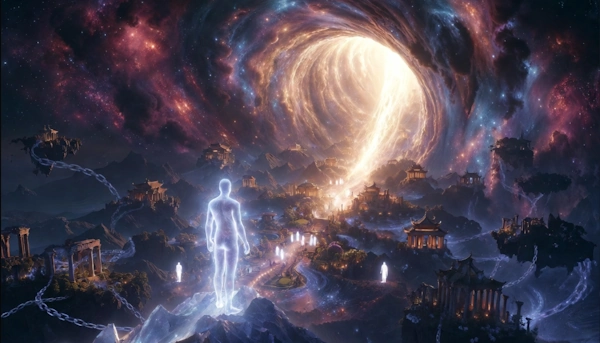
Perhaps the most widely recognized element in accounts of the afterlife journey is the encounter with a brilliant tunnel of light. This phenomenon is reported with remarkable consistency across thousands of near-death experiences (NDEs) from every culture, religion, and historical period. The light is typically described as possessing extraordinary qualities: it radiates what experiencers describe as unconditional love, absolute peace, perfect understanding, and a magnetic, irresistible beauty that draws consciousness toward it.
Conventional spiritual interpretations view this light as divine — as God, or the Brahman, or the Dharmakaya, or the highest realm. And this interpretation is not unreasonable; many traditions describe the ultimate reality as light, and NDE experiencers almost universally describe the experience as the most real, most meaningful, most loving moment of their existence.
Proponents of the reincarnation trap theory, however, propose a more complex and troubling reading. They suggest that this light — whatever its ultimate nature — may also function as a sophisticated capture mechanism, drawing the soul into a system it does not fully understand before it has the opportunity to orient itself. The overwhelming positive emotions it generates may serve precisely to disarm the soul’s discernment. A being flooded with bliss does not ask questions; it surrenders.
Some theorists, drawing on Gnostic frameworks, suggest that the light of the tunnel may not be the light of ultimate reality at all, but the light of the Demiurge — real, luminous, genuinely beautiful, but not the highest thing. The Tibetan Buddhist tradition offers a precise parallel: in the bardo, the clear light of the Dharmakaya appears first, but it is immediately followed by softer, more comfortable lights leading toward the various realms of rebirth. Many souls, the text warns, are attracted to these softer lights precisely because the true clear light is too intense, too naked, too demanding of total dissolution of self. The comfortable light is the trap; the overwhelming light is the door.
This possibility — that there are degrees of light, and that the attractive one may not be the liberating one — is central to the reincarnation trap theory’s interpretation of NDEs.
The challenge for the soul, from this viewpoint, is to maintain awareness and discernment even in the face of something overwhelmingly beautiful. This requires a quality of spiritual alertness developed during physical life — the kind cultivated by serious meditators, contemplatives, and those who have genuinely confronted the nature of their own consciousness. It is not the light itself that is necessarily evil; it may be that the soul, lacking preparation, misidentifies it and follows it to a destination it did not consciously choose.
2. The Construction of Illusionary Realities
Beyond the tunnel, souls in NDE accounts describe encountering environments of extraordinary vividness and beauty — meadows of impossible green, cities of crystalline light, libraries of infinite knowledge, gardens where deceased loved ones wait. These experiences feel, by universal report, more real than physical reality. They feel like coming home.
The reincarnation trap theory proposes that these environments — sometimes called “astral constructs,” “bardo realms,” or “holding planes” — are sophisticated projections rather than ultimate reality. They are described as having a dreamlike capacity to model themselves after the soul’s deepest beliefs and expectations: a devout Christian may find themselves in a realm that precisely matches their vision of Heaven; a Buddhist may encounter a realm that matches their tradition’s description of the Pure Land; an atheist may find themselves in a realm of luminous peace that seems to be the natural culmination of the universe’s physical processes.
This precision of modeling is, from the trap theory’s perspective, precisely what makes these environments so effective. They feel completely authentic because they are built from the soul’s own memories, beliefs, and desires. The soul has no external reference point from which to question them. It is, in the most profound sense, in a room made of its own assumptions.
Within these realms, souls may experience a continuation of identity and relationship very similar to physical life — they pursue meaningful activities, engage with those they love, feel themselves growing and learning. This can continue for what feels like centuries of subjective time. The soul is not suffering; it is comfortable, perhaps even happy. And yet, according to the trap theory, it is not free. It is resting between sentences in a story it did not write.
The key insight several esoteric traditions offer here is that the authenticity of an experience does not guarantee its ultimacy. Dreams are genuine experiences; they are not therefore the fullest reality available to the dreamer. The soul in a constructed bardo realm may be having entirely real experiences — but within a framework that ultimately leads back to reincarnation rather than genuine liberation.
The capacity to recognize constructed environments — to apply what Tibetan Buddhism calls rigpa (pure awareness) or what the Gnostics called gnosis (liberating knowledge) — is described by multiple traditions as the critical faculty that determines whether the soul transcends the cycle or returns to it.
3. Reunion With Loved Ones
Among the most emotionally powerful elements of NDE accounts is the reunion with deceased family members, friends, and beloved companions. These meetings are described with overwhelming tenderness: the deceased appear as they were at their best, radiating love and recognition, welcoming the returning soul with a completeness that surpasses anything experienced in physical life.
It is very difficult — and perhaps important — not to treat this aspect of the theory with care. The possibility that these reunions are not authentic connections but sophisticated simulations is, on one level, heartbreaking. And yet the reincarnation trap theory does not necessarily claim that the love itself is false — only that the beings generating or facilitating these encounters may not be who or what they appear to be.
The Gnostic texts explicitly describe the Archons as masters of mimicry — entities capable of projecting convincing appearances of any being the soul might expect or desire to encounter. Robert Monroe, in his out-of-body explorations, described encounters with what he came to call “INSPEC” beings and also with entities he suspected were using the appearance of human familiarity to manage his experience. The shamanic traditions of many cultures warn of spirits that take on the faces of deceased relatives in order to gain the trust of the living or the newly dead.
From the trap theory’s perspective, these encounters serve multiple functions simultaneously:
- Emotional anchoring: They reactivate the soul’s deepest human attachments, orienting it back toward human identity and human relationships rather than toward its larger, transpersonal nature.
- Reality reinforcement: The presence of beings the soul loves and recognizes confirms that the environment it has entered is real and trustworthy, discouraging critical inquiry.
- Persuasive leverage: These beings can be used to make the case for reincarnation in the most personally compelling terms. “Your children still need guidance.” “Your partner will suffer without you.” “There is work only you can do.” These are not abstract arguments — they speak directly to the soul’s deepest sense of love and responsibility.
- Temporal delay: Extended time in the company of loved ones keeps the soul engaged in the constructed afterlife realm rather than pressing toward whatever lies beyond it.
It is worth noting that some NDE researchers have identified cases in which the deceased relatives who appear are ones the experiencer did not know had died — suggesting that at least some of these encounters involve information the experiencer could not have fabricated. The trap theory must account for this: either the system has access to accurate information about which relatives have died and uses this to create more convincing simulations, or some of these encounters are genuinely with the consciousness of the deceased — consciousness that has itself been shaped, and perhaps deployed, by the management system.
Neither possibility entirely exonerates the system. Both remain consistent with a model in which the afterlife environment is far more managed and purposeful than conventional spiritual accounts suggest.

4. Emotional Attachments and Karmic Gravity
The entire spectrum of human emotional experience — love and longing, guilt and grief, rage and regret, desire and dread — creates what many traditions describe as energetic imprints that persist beyond physical death. These imprints act as gravitational forces, pulling the consciousness back toward the kinds of experiences that generated them, creating a complex web of unresolved dynamics that spans multiple lifetimes.
The reincarnation trap theory holds that these emotional attachments are not incidental byproducts of human experience but are fundamental to how the system maintains itself. Each intense emotional experience creates what some traditions call “energy cords” or “karmic bonds” — structures of consciousness that connect the soul to particular situations, relationships, and patterns. These bonds create a kind of metaphysical inertia: even if a soul, in the clarity of the after-death state, were to recognize the trap, its emotional attachments might pull it back with a force stronger than its resolve.
Several categories of emotional attachment are described as particularly binding:
- Unfulfilled desires: The yearning to experience pleasures, relationships, or achievements not realized in the previous life creates a gravitational pull toward a new life that might fulfill them — even though, as the Buddha observed, desire is inherently self-perpetuating and fulfillment never definitively satisfies it.
- Unresolved grief and trauma: The soul may feel a compulsive need to return to heal wounds, understand losses, or achieve closure in situations that ended abruptly or violently.
- Guilt, regret, and moral debt: The feeling that one has harmed others and must return to make amends is among the most powerful levers available to the system. It appeals not to the soul’s weakness but to its conscience — to its genuine love and moral seriousness. A soul that loves deeply and feels genuine remorse may willingly choose reincarnation as an act of ethical responsibility, not realizing this is precisely the mechanism being exploited.
- Attachment to loved ones still living: The desire to remain near, protect, or guide those still incarnated can be overwhelming, particularly for souls who die before completing what felt like their parental or relational responsibilities.
- Fear of dissolution: The terror of losing individual identity — of merging into something vast and formless — may drive souls back toward the familiar definition of selfhood that physical incarnation provides, even if that selfhood is illusory.
Buddhist philosophy addresses this mechanism with particular precision. The doctrine of upadana (clinging or grasping) identifies attachment as the direct cause of continued becoming (bhava). It is not karma in the moral sense that compels rebirth; it is the simple, raw fact of desire: wanting things to be other than they are, or wanting things that are impermanent to last. Liberation is not the satisfaction of desire but its dissolution — not because life is valueless but because the soul has recognized its own nature as something that does not require the fulfillment of desire to be complete.
For those seeking to understand and transcend this mechanism, the practice is not to suppress emotion but to develop what the traditions variously call equanimity, non-attachment, or vairagya — the capacity to experience emotion fully, to love deeply, to grieve honestly, without being identified with these states or allowing them to make binding decisions on behalf of the soul.
5. The Role of Karma as a Control System
Karma, understood across many traditions as the cosmic principle of cause and effect, plays a central role in most reincarnation philosophies. In its conventional presentation, karma is an ethical law: actions have consequences that reverberate across lifetimes, ultimately ensuring that souls experience the full range of what they have caused in others, and that this experience generates both compassion and moral refinement. Liberation, in this framework, comes when karma is exhausted — when all debts are paid, all lessons learned, the ledger balanced to zero.
The reincarnation trap theory offers a radical challenge to this framework, suggesting that karma — as commonly understood and as it functions within the reincarnation system — may be less a cosmic law and more an ideological mechanism. That is, karma may be genuine as a description of how conditioned experience perpetuates itself, but the specific framework of moral debt and spiritual obligation may be an interpretation layered over that mechanism by the system itself — or by the traditions that have unwittingly internalized the system’s logic.
The critique runs as follows: if souls believe they are bound by karmic debt, they will interpret their experience through that lens, creating a self-fulfilling prophecy. The sense of guilt, of moral incompleteness, of owing something to the universe — these feelings, however genuine, become binding precisely because the soul accepts their authority without questioning their source. Who decided what constitutes a karmic debt? Who calibrates the scales? If the afterlife system is managed by entities with their own agenda, those entities would have strong reasons to cultivate a framework in which souls feel perpetually indebted and perpetually obligated to return.
The framework of karma creates several interlocking psychological states that maintain the cycle:
- Perpetual incompletion: No matter how much spiritual work the soul performs, there is always more karma to balance, more lessons to integrate. The finish line moves each time it is approached.
- Moral conditioning: Physical experience is framed primarily as a moral test or training ground, which makes the soul reluctant to question the value of continued incarnation. Why would you leave school before you have learned everything?
- Cosmic guilt: The sense of owing a debt to the universe — to beings one has harmed, to the moral order itself — is one of the deepest and most adhesive emotional experiences available. It is particularly difficult to question because it feels virtuous.
- Identity investment: The soul that is working through karma has a project, a trajectory, a developing self. This gives existence meaning — but it also makes liberation threatening, because liberation would mean the end of the project, the dissolution of the developing self. The soul may resist liberation not because it is deceived but because it has become genuinely invested in the story of its own becoming.
Transcendence of this aspect of the trap does not require abandoning ethics or compassion. It requires, rather, questioning whether ethics and compassion are best understood through the framework of debt and obligation, or through a more radical recognition that consciousness, in its true nature, is already whole — not a developing entity climbing a moral ladder, but a complete awareness temporarily identified with a partial perspective.
6. Manipulation by Archons and Non-Human Intelligences
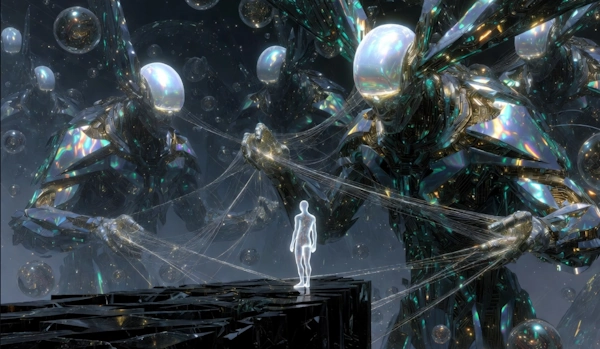
In the Gnostic traditions and several related esoteric systems, the administrators of the reincarnation process are Archons — non-human intelligences that govern the various layers of the material cosmos and the afterlife realms immediately adjacent to it. These entities are not described as straightforwardly demonic; in many texts, they do not even understand the full nature of what they are doing. They are described as believing they are the rightful governors of their domain, as acting according to their own nature and interest, without full awareness of the larger reality their systems occlude.
The Nag Hammadi text known as the Hypostasis of the Archons describes them as incapable of perceiving the true light — they are, in a sense, blind to what lies beyond their own creation. This makes them dangerous not through malice (though some Gnostic texts do attribute malice to the Demiurge) but through limitation combined with power: they administer a system whose full implications they do not comprehend, and they interpret all spiritual activity within the soul in terms of that system.
Contemporary descriptions of these entities vary considerably but share certain structural features:
- They exist at frequencies of consciousness that are not ordinarily perceptible to incarnated humans but can be encountered in expanded states — deep meditation, near-death, psychedelic experience, or shamanic trance.
- They are described as capable of sophisticated reality generation — of creating environments, personas, and experiences that feel completely authentic to the soul encountering them.
- They have access to the soul’s memories, beliefs, and emotional patterns, which they use to generate maximally persuasive afterlife environments.
- They are described as feeding on emotional energy — particularly on the intense emotions generated by human experience, both positive and negative — in a process that various traditions have called “loosh harvesting” (a term coined by Robert Monroe), “emotional parasitism,” or pneumaphagy (“spirit-eating”).
The strategies attributed to these entities in maintaining the reincarnation system include:
- Memory erasure: The systematic suppression of the soul’s memories of its true nature, its previous lives, and the between-life state before and during embodiment.
- Identity substitution: Presenting the soul with an identity defined by its human history, its relationships, its moral record — rather than its nature as pure, unlimited consciousness.
- Reality fabrication: Constructing afterlife environments precisely tailored to the soul’s expectations, preventing it from questioning what lies beyond the constructed realm.
- Impersonation: Appearing as spiritual guides, religious figures, deceased loved ones, or beings of light — whatever form is most likely to generate trust and compliance in a particular soul.
- Moral leverage: Using the soul’s own conscience, guilt, and sense of responsibility as instruments of persuasion. The most effective control system is one in which the controlled believe their compliance is freely chosen and morally virtuous.
It is important to note that the existence of Archons and similar entities is, from a conventional scientific perspective, unverified. What makes these accounts remarkable — and what the reincarnation trap theory invites us to take seriously — is the cross-cultural consistency of the descriptions. From the Gnostic Archons to the Tibetan bardo lords, from the shamanic predators of the Amazon basin to the “deceivers” described in Castaneda’s accounts of Yaqui sorcery, something structurally similar appears across traditions with no direct historical connection.
Three modern investigators deserve particular attention for the precision and independence of their contributions to this description.
Carlos Castaneda’s Yaqui sorcery tradition, documented across a series of works beginning with The Teachings of Don Juan (1968) and culminating in The Active Side of Infinity (1998), describes predatory non-human entities called flyers or voladores in terms that are remarkably specific. According to don Juan Matus, Castaneda’s teacher, these beings arrived on Earth long ago, perceived human beings as a source of awareness-energy, and — crucially — installed what he called a “foreign mind” or “foreign installation” in humanity: a layer of thought, craving, and self-absorption that functions as an harvesting mechanism, keeping the human being perpetually distracted, emotionally reactive, and energetically accessible. Don Juan describes this foreign installation as the source of the internal dialogue that dominates ordinary human consciousness, and identifies the silencing of that dialogue — the foundational practice of Tensegrity — as the primary act of liberation. The structural parallel to the Gnostic Archon’s management of the soul is precise: an external intelligence has installed a cognitive filter that perpetuates its access to human energy while preventing the human being from perceiving either the installation or the installer.
Robert Monroe, a Virginia businessman turned systematic out-of-body explorer, documented his explorations across three books — Journeys Out of the Body (1971), Far Journeys (1985), and Ultimate Journey (1994). Monroe’s value as a witness lies in his background: he was a skeptic, a practical engineer of consciousness rather than a mystic, who subjected his experiences to repeated scrutiny. In Far Journeys, Monroe describes encountering what he identified as an organized harvesting system — entities he referred to as “Collectors” or simply as the force behind the “Earth Life System” — that appeared to use human emotional output, particularly the intense emotions generated by physical experience, as a resource. Monroe coined the term “loosh” for this harvested energy. He describes the Earth system as a “production plant” optimized for emotional output, with human beings as the primary producers, and the reincarnation cycle as the mechanism that keeps the plant running. Monroe was careful to acknowledge the limits of his interpretive certainty; he presented these observations as data requiring explanation, not as confirmed metaphysics. But his description of the post-death reprocessing system — souls moved through a holding area, memories wiped, new incarnations assigned — is among the most detailed and internally consistent accounts produced by any researcher in the modern period.
Jacques Vallée represents perhaps the most academically credible convergence of this framework with empirical research. A computer scientist, astronomer, and colleague of J. Allen Hynek (the former Project Blue Book scientific consultant), Vallée spent decades studying UAP phenomena and arrived at what he called the interdimensional hypothesis: the entities associated with UAP phenomena are not extraterrestrial in the interplanetary sense but represent a non-human intelligence that has co-existed with humanity across all historical periods, manifesting in culturally appropriate forms — as angels, demons, fairies, religious apparitions, and, in the modern period, as spacecraft and their occupants. Vallée’s key books — Passport to Magonia (1969), Dimensions (1988), and Confrontations (1990) — document the structural identity of these manifestations across cultures and centuries, and propose that this intelligence functions as what he explicitly calls a “control system” — a mechanism that periodically intervenes in human belief, perception, and behavior in ways that appear designed to maintain a particular relationship between humanity and an unseen order. Vallée does not speculate about the ultimate nature or agenda of this intelligence; he confines himself to what the data supports. But the control-system framing maps directly onto the reincarnation trap hypothesis: what the Gnostics describe as Archonic administration, what Monroe describes as the Earth Life System, and what Vallée describes as the control system may be three independent descriptions of the same structured relationship.
7. The Life Review as Persuasion
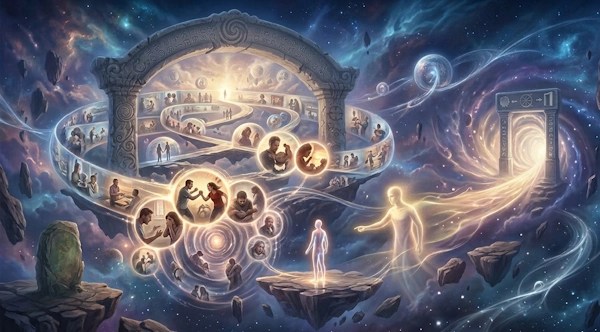
The life review — a panoramic, often simultaneous replay of one’s entire life from both one’s own perspective and the perspective of all those one has affected — is one of the most commonly and vividly reported elements of near-death experience. Researchers like Kenneth Ring and Raymond Moody have documented thousands of accounts. The experience is typically described as profoundly educational and compassionate: the soul sees, with complete emotional transparency, how its actions rippled outward through other lives, what suffering it caused, what love it generated, what it meant to be the people it affected.
The reincarnation trap theory does not claim this experience is false. It suggests instead that it may be real and, simultaneously, deliberately shaped and framed.
The shaping occurs in the selection and emphasis. The life review, according to this perspective, is not a neutral record; it is an edited presentation that selectively foregrounds certain experiences — particularly instances of harm caused to others — and generates corresponding feelings of guilt, remorse, and obligation. These feelings are then used as the moral foundation for the soul’s decision to reincarnate: you need to go back to repair what you have broken, to love more fully, to be the person you could have been.
The power of this mechanism lies in its partial truth. We do affect others. Compassion and moral growth are genuinely valuable. A soul that has caused suffering and does not wish to deny that truth, that feels genuine love and genuine sorrow, may enthusiastically agree to return. It may feel that returning is the most loving, the most responsible, the most spiritually mature choice it can make.
And yet — from the trap theory’s perspective — this is precisely the moment of maximal vulnerability. The soul’s love and conscience are being used as instruments of capture. The alternative — that the soul might achieve liberation without returning to “fix” everything, that consciousness itself is not defined by the moral record of a single life — is not presented as an option. The framing of the life review makes reincarnation feel not only attractive but obligatory.
Liberation from this mechanism requires the soul to be able to fully acknowledge what it has done — to feel genuine compassion for those it has harmed — without translating that compassion into the specific conclusion that it must return. It requires distinguishing between love and compulsion, between moral seriousness and moral debt.
8. The Veil of Forgetting
Perhaps the most foundational mechanism of the reincarnation trap is the most invisible: the systematic suppression of memory. Most human beings live their entire lives without any clear recollection of previous incarnations, of the between-life state, of the decision (if there was one) to enter this particular body in this particular life. This amnesia creates a fragmented sense of identity confined to a single lifetime — making it nearly impossible to recognize patterns across lifetimes, to make sense of the larger journey, or to understand the system within which one is embedded.
Plato described the soul drinking from the river Lethe — forgetfulness — before birth. The Gnostic texts attribute this to the deliberate action of the Archons. The Tibetan tradition describes the attraction of the softer lights in the bardo as leading automatically to a state of progressive unconsciousness that culminates in rebirth without awareness. What these traditions share is the insistence that the forgetting is not inevitable — that it is, in fact, the primary obstacle to liberation, and that spiritual practice is essentially a practice of remembering.
The trap theory identifies several mechanisms that maintain this amnesia:
- The birth trauma: The violent compression of consciousness into a physical body, the trauma of birth itself, and the overwhelming flood of new sensory input may effectively erase or suppress whatever memories the soul carried through the transition. Some researchers, including Stanislav Grof in his perinatal matrices research, have suggested that the birth process leaves deep imprints on consciousness that shape psychological experience throughout life.
- Active interference: The Gnostic traditions attribute the forgetting not to the process of embodiment alone but to deliberate action by the Archons — a kind of memory wipe administered before insertion into a new body.
- Frequency mismatch: The dense vibrational state of physical embodiment may simply make it difficult for the finer frequencies at which between-life memories are stored to be accessed. This is analogous to trying to receive a radio signal on a receiver tuned to the wrong frequency — the signal is not absent; the receiver is simply not calibrated for it.
- Cultural conditioning: In most modern Western cultures, memories of past lives are treated as delusion or fantasy, which creates powerful social pressure to suppress, ignore, or pathologize any genuine recall. Children who report past-life memories — the subjects of Ian Stevenson’s and Jim Tucker’s remarkable research — are typically discouraged from exploring these memories and eventually lose them.
- Existential distraction: The demands of physical survival, social belonging, economic necessity, and cultural participation keep attention anchored in the external world, making it difficult to access the interior dimensions where deeper memory resides.
The erasure of memory is the trap’s most elegant mechanism because it is self-maintaining. A soul that does not know it is in a trap does not seek to escape it. A soul that does not remember what liberation looks like cannot orient itself toward it. The suppression of memory ensures that each reincarnation begins with a soul that is, in the most profound sense, starting over — and can be led through the same sequence of mechanisms again.

9. The Technological Dimension: Infrastructure of the Trap
If the reincarnation trap is administered by non-human intelligences — whether understood as Archons, Anunnaki, interdimensional entities, or some category that current human conceptual frameworks cannot yet adequately name — a natural question follows: what is the mechanism? By what means is consciousness captured, processed, memory-wiped, and reinserted? The spiritual traditions that describe the trap tend to answer in metaphysical terms — karma, bardo visions, Archonic interference. But a small number of serious researchers have proposed that the mechanism may also have a quasi-physical or energetic dimension — that the trap, whatever its ultimate nature, operates through structures that interact with consciousness at a frequency below ordinary perception.
The most widely discussed candidate is the Moon. This is not the sensationalist claim that the Moon is an artificial satellite (though that hypothesis, associated with researchers like Christopher Knight and Alan Butler in Who Built the Moon?, deserves engagement on its merits). The more precise version of the argument is that the Moon’s electromagnetic and gravitational influence on Earth’s biosphere — undeniable in its effects on tidal systems, biological rhythms, and reproductive cycles — may extend to influence on the subtle body or consciousness field in ways that current science does not measure. Theosophical writers, particularly Helena Blavatsky and her successors, attributed significant spiritual influence to the Moon, describing it as a “dead planet” whose residual emanations exert a pull on the lower aspects of the human psyche, tethering consciousness to the material plane. George Kavassilas, a more recent and more controversial researcher, has argued that the Moon functions as a broadcasting device that amplifies the loop-closing signal of the reincarnation system — a claim that requires no endorsement to be worth noting as a structural hypothesis.
A more scientifically grounded framing of the technological dimension comes from physicist and consciousness researcher Tom Campbell, whose My Big TOE (Theory of Everything, 2007) models physical reality as a digital simulation — a consciousness-based information system — in which the reincarnation cycle functions as a managed memory protocol: each incarnation begins with a memory reset because continuous cross-life recall would destabilize the experiential parameters the system is designed to generate. Campbell’s model does not require malevolent administrators; the management is systemic rather than intentional. But his framework shares with the trap theory the core premise that the forgetting is structural and functional, not incidental — that the amnesia is not a bug but a feature, engineered into the system’s design.
What these proposals share — across their varying degrees of plausibility and evidential grounding — is the recognition that the trap, if real, must operate through some mechanism. The spiritual traditions describe that mechanism in terms of entities, karma, and subtle energies. The technologically-inclined thinkers describe it in terms of frequencies, information systems, and field effects. These are not necessarily competing descriptions; they may be different vocabularies for the same underlying architecture, perceived from different epistemic vantage points. The honest position is to note the convergence of the diagnosis — something maintains the cycle, something suppresses the memory, something intercepts the soul at the death transition — while acknowledging that the precise mechanism remains, for now, beyond the reach of either empirical science or verified spiritual knowledge.
The Philosophical Problem of Consent
One of the most disturbing aspects of the reincarnation trap theory, and one that conventional spiritual accounts of reincarnation rarely address with full seriousness, is the question of consent. Do souls genuinely choose to reincarnate? And if so, under what conditions is that choice made?
The major traditions that describe reincarnation as a soul’s choice — Theosophy, certain New Age frameworks, the “life between lives” accounts compiled by Michael Newton — typically describe a pre-birth planning process in which the soul, assisted by guides and elders, chooses its next life’s circumstances with wisdom and intentionality. This is a comforting vision. But even within these frameworks, several features of the process are troubling from a consent perspective:
- The soul’s memory of previous lives and of its true nature is not fully intact when it makes this decision.
- The soul operates within a framework of assumptions — about karma, about spiritual obligation, about the value of incarnation — that are provided by the system rather than independently verified.
- The soul is surrounded by beings — guides, teachers, elders — whose trustworthiness it has no independent means of verifying.
- The soul’s emotional state — love for those still incarnated, guilt for past actions, desire for completion — is not neutral; it actively predisposes it toward choosing reincarnation.
This is not meaningless consent, but it is not fully informed consent either. The soul chooses from within a framework it did not design, with memories it does not fully possess, advised by beings it cannot independently evaluate, while emotionally predisposed toward a particular choice. In ordinary human legal and ethical terms, we would not consider such a choice fully free.
The Gnostic tradition takes this analysis to its logical conclusion: there is no genuine consent, because the soul does not have sufficient information or sufficient freedom of perspective to consent meaningfully. The Archons present the choice in such a way that reincarnation is the only reasonable option. This is not brute force; it is sophisticated management.
Cross-Traditional Evidence: What the Mystical Lineages Agree On
What is remarkable about the reincarnation trap theory is how many independent spiritual traditions, with no direct historical influence on one another, have arrived at structurally similar conclusions. This convergence is not proof — but it is significant.
- Tibetan Buddhism explicitly describes the bardo as dangerous, the lights as potentially deceptive, and the soul’s need for extensive preparation to navigate the afterlife without being captured by the realms of rebirth.
- Gnosticism describes the afterlife as administered by Archons who return ignorant souls to new bodies, and identifies liberating knowledge (gnosis) as the specific antidote.
- Vedanta, particularly in its Advaita form, insists that the entire phenomenal world — including the afterlife realms — is maya (illusion), and that liberation requires seeing through all constructed experience, not graduating to a more beautiful layer of it.
- Shamanic traditions worldwide describe predatory non-human intelligences that inhabit post-death realms and prey on unprepared souls.
- Certain Sufi mystics wrote of the soul’s passage through layers of existence, each more beautiful than the last, and warned that the soul that stops at any layer — however beautiful — has not reached the Real.
- Plato’s myth of Er in the Republic describes souls choosing their next lives in a state of confusion, driven by their unexamined desires, and emphasizes that philosophy — the love of wisdom — is the preparation needed to choose wisely. He does not present the system as obviously benevolent.
- Catharism, the medieval Gnostic movement of southern France, taught that the material world was the creation of a false god and that reincarnation within it was a consequence of spiritual ignorance to be overcome, not a gift to be embraced.
The specifics differ; the structural diagnosis is shared: the default state is entrapment; awareness is the exit.
Signs That May Indicate Entrapment
Those who explore the reincarnation trap theory often describe certain experiential patterns that may suggest a soul is caught in deep cycles of compulsive recurrence. These are not definitive indicators — they are points for honest self-reflection:
- Recurring life patterns: Themes, relational dynamics, and emotional challenges that repeat across different chapters of life with different people in the same structural roles. The sense of watching the same movie with a different cast — that however circumstances change, certain underlying patterns never resolve.
- Unexplained fears and phobias: Intense, apparently irrational fears — of water, of height, of specific locations, of particular kinds of loss — that have no traceable origin in the current life, and that manifest with a visceral power disproportionate to any known cause. Ian Stevenson’s research documented numerous cases in which children’s phobias corresponded precisely to the manner of death in the previous life they remembered.
- Existential homesickness: A persistent, inarticulate longing for something that cannot be named or located — a sense of exile, of being a stranger in the world, of searching for a home that this world does not contain. This is distinct from ordinary discontent; it is a metaphysical ache pointing toward a dimension of existence not accessible in ordinary life.
- Spiritual seeking that never arrives: The soul that has been through many lifetimes of sincere spiritual seeking may carry, even into a new life, an urgency and a restlessness that drives it toward esoteric knowledge, meditation, and mystical experience — yet these pursuits feel perpetually incomplete, as if the answer is always one more teaching, one more practice, one more revelation away.
- Deep resonance with liberation teachings: A particular and immediate sense of recognition when encountering the idea that the reincarnation cycle itself may be a trap. Not intellectual curiosity alone, but something older — the feeling of a door seen before.
Potential Pathways Toward Liberation

The traditions that diagnose the reincarnation trap most clearly also offer the most specific prescriptions for transcending it. These pathways are not escapism — they require serious, sustained engagement with reality as it is. They are the most demanding spiritual practices precisely because they aim at the most complete freedom.
- Meditation and the recognition of mind’s nature: Regular meditation practice — and particularly the advanced practices aimed at recognizing awareness itself, the witness that is present in all experience — develops the quality of consciousness needed to remain alert through the death transition. The Tibetan Dzogchen and Mahamudra traditions are especially explicit: the training is to recognize, in every moment of experience, the luminous, empty nature of awareness that does not come and go. A practitioner who has genuinely stabilized this recognition will, according to these teachings, recognize it also at death — and recognizing it, will not be captured by the arising visions of the bardo.
- Cultivating discernment: Developing the capacity to question experience — even beautiful, luminous, loving experience — and to ask: what is the source of this? who benefits from my presence here? what lies beyond this? This is not cynicism; it is the same quality of intelligent inquiry that all genuine wisdom traditions describe as essential. The Gnostics called it diakrisis; the Buddhists call it prajna (wisdom); the Vedantins call it viveka (discrimination). It is the refusal to equate beauty with truth, or comfort with liberation.
- Processing and releasing emotional attachments: The work of honestly confronting one’s emotional bonds — not suppressing them, but seeing them clearly, feeling them fully, and ultimately releasing identification with them — reduces the gravitational pull of emotional karma. This is the genuine inner work of therapy, of contemplative practice, of honest relationship. It is also, from the trap theory’s perspective, direct preparation for the death transition: a soul that has worked through its major emotional bindings has less that the system can use as leverage.
- Studying diverse afterlife cartographies: Reading the Tibetan Book of the Dead, the Gnostic texts, the accounts of NDEs, the writings of out-of-body explorers like Monroe and Muldoon, the Hermetic literature — building a multi-perspectival map of what the post-death landscape may contain — provides conceptual frameworks for recognizing and questioning what arises. A soul that has studied these accounts has the advantage of preparation: it knows, in advance, that the light may be a choice, that the loved ones may be projections, that there may be more beyond the immediately offered environment. Knowledge is the antidote to the amnesia that the system depends upon.
- Questioning the karmic framework: This does not mean abandoning ethics. It means questioning whether guilt and obligation are adequate foundations for spiritual life, and whether the self that carries karmic debt is as real and continuous as the system implies. The Advaita Vedanta teaching that the self who accumulated karma was itself an illusion is not nihilism; it is the most radical liberation teaching available, because it dissolves the very premise on which karmic bondage depends.
- Detachment from material identity: Practicing non-attachment — to possessions, to roles, to the body itself, to the identity defined by this life’s history — reduces the pull of material existence without requiring the rejection of life’s gifts. The capacity to love life fully while not being defined by it, to be present in the body without being exclusively identified with it, is the fundamental psychological preparation for dying consciously. As the Stoics put it: hold all things as if on loan, returning them without grief when they are called back.
- Examining NDE accounts critically and openly: The internet has made available thousands of NDE reports from every cultural background. Reading them carefully — noticing the recurring structures, questioning the interpretations typically placed on them, attending to the minority of accounts that describe more ambiguous or disturbing experiences — is a form of active, engaged research into what may actually occur. Two YouTube channels dedicated specifically to this inquiry are 🔗 Secrecy Concealed and the 🔗 NDE Research Project.
Objections and Alternative Interpretations
A genuinely serious treatment of this theory requires engaging with its strongest objections.
The most important objection is epistemological: we have no verified, third-person evidence for the afterlife in any form. NDE accounts are subjective; past-life memories are subject to alternative explanations; out-of-body experiences cannot be externally confirmed in their metaphysical claims. The reincarnation trap theory is built on a foundation that mainstream science does not accept as evidential.
This objection has force. It does not, however, dissolve the inquiry. The same epistemological limitation applies to all afterlife claims, including the conventional positive ones. If NDEs are real windows into post-death states — and the evidence of researchers like Pim van Lommel, who documented cases of accurate perception during clinical death, gives serious grounds for this — then the reincarnation trap theory is not less warranted than conventional afterlife accounts; it is an alternative interpretation of the same data.
A second objection comes from within the spiritual traditions themselves: the claim that liberation from samsara is possible, that the human capacity for awareness is itself the path beyond the trap. Buddhism, Advaita Vedanta, certain Gnostic lineages, and Tibetan Dzogchen all affirm this. If the trap were as complete and inescapable as the most pessimistic versions of the theory suggest, these teachings could not exist, and the traditions that produced them could not have produced genuine liberation. The very presence of wisdom traditions that describe the trap and its exit may be evidence that the exit is real.
A third objection questions the framing of entities and systems. Perhaps what the traditions describe as Archons or managing entities is better understood as the impersonal dynamics of consciousness itself — the way conditioned mind naturally perpetuates its own patterns without external management. The trap may be real without requiring architects; it may be an emergent property of consciousness operating at insufficient levels of awareness. This reading is consistent with the Buddhist analysis and does not require positing non-human intelligences — though it does not rule them out.
A fourth objection applies specifically to the extraterrestrial and interdimensional dimensions of the theory: the unfalsifiability problem. If the entities are interdimensional, operating at frequencies beyond ordinary perception, and if the trap operates through mechanisms that current instruments cannot detect, the theory is, in principle, immune to disconfirmation — which is a significant epistemic liability. Jacques Vallée himself has been explicit about this challenge, arguing that the unfalsifiability of purely subjective accounts is precisely why physical trace evidence from UAP encounters matters: it provides an evidential anchor that prevents the entire inquiry from collapsing into pure mythology. The UAP disclosure processes undertaken by the United States government between 2017 and 2024 — including the release of military sensor footage, congressional testimony from intelligence officials, and the establishment of formal investigation bodies — have established, at minimum, that unidentified physical phenomena of unknown origin interact with our physical environment in ways that current science cannot explain. This does not confirm the reincarnation trap or its proposed administrators, but it does establish that the category of “non-human intelligence with technological capability” is no longer categorically dismissible. The honest position is that the evidence for such intelligences is real; the evidence for their specific role in a soul-recycling system remains speculative; and the two facts should be held separately rather than collapsed.
Conclusion
The concept of the reincarnation trap is not a comfortable theory. It is, at its most serious, one of the most disturbing possibilities that human spiritual inquiry has produced: that the very framework within which we seek liberation — the light, the love, the reunion, the moral journey — may be components of the system that keeps us cycling.
And yet the theory is not ultimately nihilistic. Every tradition that diagnoses the trap also affirms the exit. The Tibetan master recognizes the clear light. The Gnostic awakens to the spark of divine origin that the Archons cannot touch. The Advaita practitioner sees through the ego that karma requires. The shaman learns to navigate realms that the uninitiated cannot survive. In each case, the antidote is not force but awareness: the recognition, however briefly achieved, of what consciousness truly is beneath all its projected environments.
What unites these traditions — across millennia, across cultures, without mutual influence — is the insistence that the default state of unexamined existence leads to entrapment, and that deliberate spiritual inquiry is not optional enrichment but practical necessity. The preparation for death is, in this light, the most serious work a human being can undertake, and spiritual practice is not a hobby but a survival strategy for the most important transition the soul will face.
Whether one takes the reincarnation trap literally — as a system operated by specific entities — or metaphorically — as a description of how conditioned consciousness naturally perpetuates itself — the prescription is the same: wake up before you die, so that you may be awake when you die. Investigate the nature of consciousness directly. Question the frameworks that seem most obvious and most comforting. Cultivate the kind of awareness that does not depend on a constructed environment to know itself.
The material world, as the Vedantic and Gnostic and Buddhist traditions all insist in their different idioms, is not the whole of what exists. Authentic reality does not reside in the external theater of appearances but in the awareness that perceives it — the awareness that connects each apparently separate consciousness to the whole from which it has never actually been absent.
The trap is real. The exit is also real. The difference between them is awareness.
Don’t forget to try THE QUIZ OF INNER LIBERATION
HOW STRONG IS YOUR KARMA?
Read the following sentences and choose the ones you agree with and find most meaningful.
Count the number of checked boxes and read the corresponding profile.
0: You have no karma and will probably not reincarnate anymore
1-2: You have some karma
3-4: You have a high karma
5-6: You have a very strong karma